Passive Income in 2026: What Works for Beginners
Passive Income in 2026: What Works for Beginners
You've probably seen the promises online. Someone claims to make thousands of dollars a month while sleeping. Usually, they're just selling a course on how to do exactly the same thing. It's easy to feel like you're falling behind.
What actually works for passive income in 2026? The reality is grounded: true passive income comes from either investing your money into simple financial products or putting in heavy upfront work to build a scalable asset. It isn't a magic ATM.
According to the U.S. Census Bureau (2024), only about 20 percent of American households receive any passive income at all. Among those that do, the median amount is roughly 4,200 dollars per year. That's a nice bonus, but it's far from instant financial freedom.
If you want to build extra income streams this year, you need a realistic map. Based on recent financial research and dozens of real Reddit case studies, here's what actually works for beginners.
Why Beginners Need Passive Income in 2026
Economic pressures are driving the unprecedented need for supplemental income streams. You aren't imagining the pressure to earn more. Young professionals and new earners face an economy defined by high living costs and widening wealth gaps.
According to Debt.com (2025), 69 percent of respondents live paycheck to paycheck. That number is up from 50 percent just a few years ago. Furthermore, according to Bankrate (2025), more than half of Americans can't cover a 1,000-dollar unexpected expense without borrowing. It's no wonder that middle-income millennials live paycheck to paycheck and desperately want a way out.
According to the Congressional Budget Office (2024), real GDP growth is expected to slow down to 1.4 percent in 2025. Inflation is projected to remain above the Federal Reserve's 2 percent target until 2027. This means cash sitting in a standard checking account actively loses its purchasing power.
Wages and salaries are still the largest income source for most people. But according to the Federal Reserve Bank of Minneapolis (2024), wealth and capital ownership are becoming the decisive factors in economic resilience. Only about 60 percent of total household income now comes from traditional wages and benefits. The rest comes from capital income and transfers.
Because of this shift, expectations around extra income are incredibly high. According to a generational investing study (2025), 88 percent of Americans believe passive income is necessary for financial security in retirement. Another 83 percent think having multiple income streams is essential. The motivation isn't about buying fancy cars. It's about risk management, autonomy, and simple survival.
The bottom line: Traditional wages are no longer enough to guarantee financial security, making extra income streams essential for long-term survival.
The Two Realistic Lanes of Passive Income
Before you start building, it helps to understand the terminology. Passive Income — earnings derived from assets or deferred work that require relatively little ongoing effort to maintain.
Government agencies define it strictly as income derived from assets like interest, dividends, and rental properties. Financial institutions generally define it as earnings that require significant upfront work or capital. The key is that it isn't about eliminating work completely; it's about decoupling your income from your hourly labor.
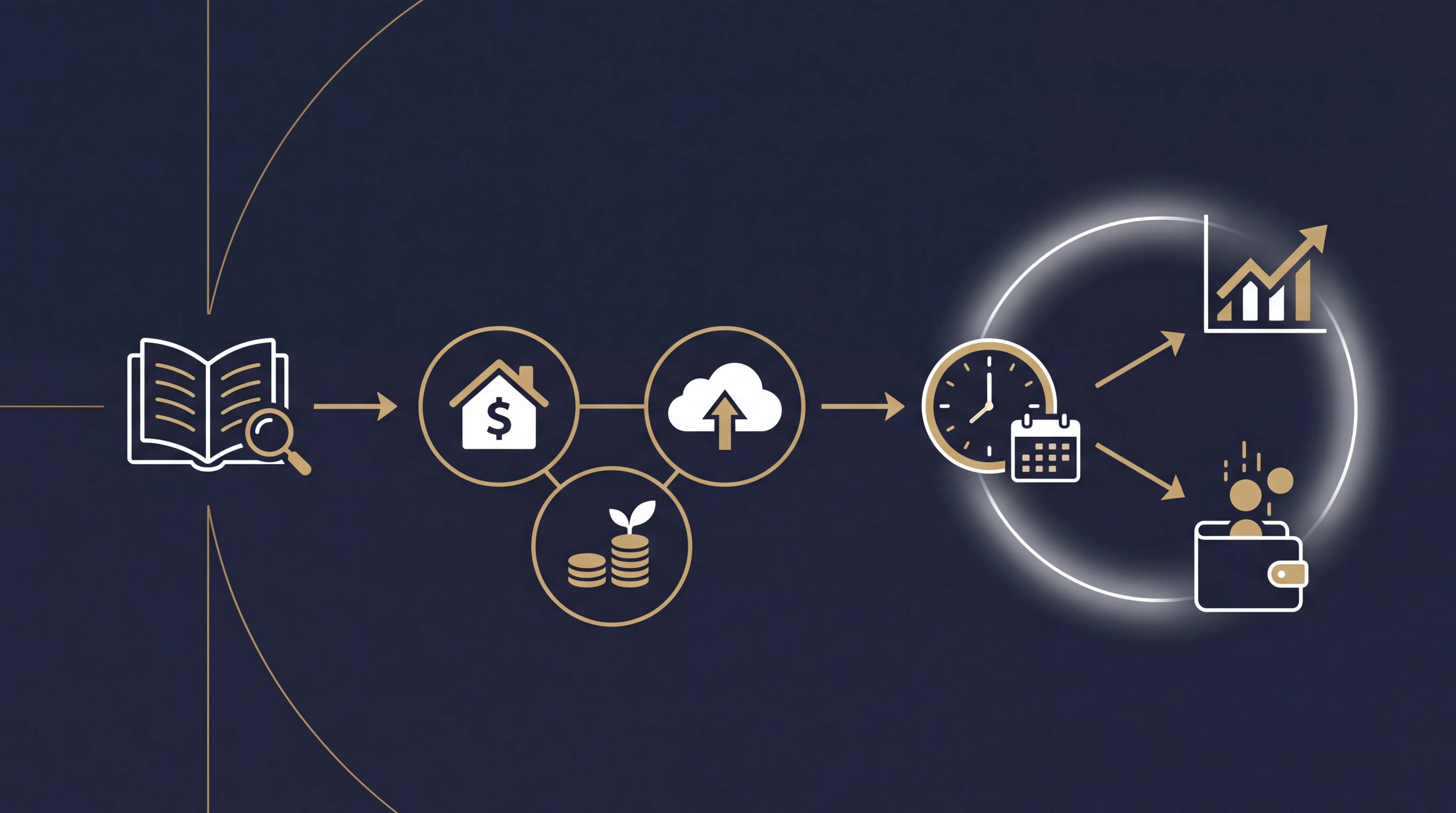
Academic research and real-world case studies generally divide realistic passive income into two distinct lanes.
Lane A: Deploying Capital
This lane involves putting cash into relatively low-effort financial vehicles. Think high-yield savings accounts, certificates of deposit (CDs), or broad index funds. The returns are modest but highly reliable. They also require almost zero additional labor.
Lane B: Deploying Deferred Work
This lane involves building digital or physical assets that can scale. Examples include niche software tools, e-books, templates, online courses, or content channels. This requires a heavy upfront time commitment. It also comes with significant uncertainty. You might work for six months before seeing a single dollar.
Here's what this means: You must choose to invest either your money upfront (Lane A) or your time upfront (Lane B) to build a sustainable income stream. Both lanes reject the myth of effortless wealth.
The Real Data Behind Supplemental Income Streams
The reality of side gig earnings is often much lower than internet gurus claim. Because the term "passive income" gets thrown around so loosely, it helps to look at the hard data on side gigs and supplemental income.
According to independent worker surveys (2025), the average side gig brings in about 1,122 dollars per month, but the median is only 200 dollars per month. This massive gap between the average and the median tells a crucial story. A very small minority of high earners pull the average up. Meanwhile, the vast majority of participants earn relatively small sums.
According to industry research (2026), truly "meaningful" passive income is achieved by only about 12 percent of Americans. This is defined as earning more than 500 dollars per month.
If you decide to start a side project, you should treat it like a small business. According to the U.S. Bureau of Labor Statistics (2025), roughly 20 percent of new businesses fail in their first year. Nearly half fail within five years. If you want to start a side business for under $500, you need to manage your risks and keep your expectations grounded.
The bottom line: Treat your passive income project like a real business and keep your initial financial expectations grounded in reality.
Case Study 1: Passive Income Through Dividend and Index Funds
Investing in broad market funds is the most reliable, lowest-effort method for generating passive income. When you look at Reddit communities focused on financial independence, the most successful form of passive income is arguably the most boring. It's Lane A in action.
Users consistently report that their most reliable passive income comes from buying broad index funds and dividend-paying Exchange-Traded Funds (ETFs) — investment funds traded on stock exchanges that hold a basket of assets like stocks or bonds.
The math here is straightforward. If you invest in a dividend ETF that yields 3 percent annually, you need 10,000 dollars invested to generate 300 dollars a year in truly passive income. It isn't going to replace your day job anytime soon. But it's entirely uncoupled from your daily labor.
Many beginners make the mistake of chasing high-yield dividend stocks that are fundamentally unstable. Real case studies show that young professionals who succeed with this method focus on broad market exposure. They set up automatic transfers from their checking accounts to their brokerage accounts every payday.
If you're new to this concept, index funds are the simplest way to start investing. They allow you to own a tiny piece of thousands of companies at once. This spreads out your risk while capturing the general upward trend of the market.
Here's what this means: Consistent, automated investing in broad market funds is the safest path to true passive income, even if the initial returns are small.
Case Study 2: The Reality of Real Estate Passive Income
Real estate investing requires significant active management before it becomes truly passive. Real estate is the classic American dream for passive income, but the data and case studies show it's far more active than most beginners realize.
According to aggregated landlord data (2025), the average U.S. landlord earns about 16,166 dollars in gross rental income per property per year, but the net profit after expenses is only about 8,552 dollars. This implies that roughly 53 percent of gross rent is absorbed by costs. These include mortgage payments, taxes, insurance, maintenance, and vacancy periods.
This translates to a net monthly income of around 713 dollars per property.
On Reddit, landlords repeatedly emphasize that these profits depend on careful math before buying. A property is only a good investment if the Cash-on-cash return — a rate of return that calculates the cash income earned on the cash invested in a property — makes sense. Also, rental income is only "passive" once you build strict systems. You need solid processes for rent collection, maintenance coordination, and tenant communication.
Many beginners buy a property assuming the rent check will just appear in their mailbox every month. Real case studies show that dealing with a broken water heater at two in the morning is a very active form of work. Property management companies can handle these headaches. But they typically take 8 to 12 percent of your gross rent, eating further into your margins.
The bottom line: Rental properties can generate substantial wealth, but they act more like a part-time job than a passive income stream unless you hire property management.
Case Study 3: Earning Passive Income with Digital Products
Creating digital products requires heavy upfront labor but offers infinite scalability with zero marginal cost. For young earners who don't have thousands of dollars to invest in index funds or real estate, Lane B is the most popular choice. This involves creating digital products like e-books, budget templates, crochet patterns, or stock photography.
Reddit case studies show a very clear pattern for success in this area. The users who actually make money don't expect overnight success. They spend six to twelve months creating high-quality products. They also learn how to optimize their listings on platforms like Etsy or Amazon.
One common narrative involves a user creating a digital planner. The first few months yield zero sales. The user then tweaks the design, improves the search keywords, and starts seeing a trickle of income. Eventually, that specific product might generate 50 to 100 dollars a month. To reach the coveted 500-dollar mark, they usually have to build a portfolio of five to ten different products.
The advantage here is that once a digital product is created and listed, the cost of delivering it to the next customer is zero. The income becomes decoupled from your hours. The downside is platform dependence. If an algorithm changes, your traffic can disappear overnight. Successful creators mitigate this by eventually building their own email lists and websites.
Here's what this means: Digital products are ideal for beginners with more time than money, provided you have the patience to build a portfolio of assets over several months.
The Passive Income Tax Trap You Need to Avoid
Failing to account for self-employment taxes can destroy your passive income profits. One of the most painful lessons for beginners building supplemental income is the tax bill.
If you earn money from a side project treated as self-employment, you're subject to the Self-employment tax — a 15.3 percent tax on your net business income that covers your contributions to Social Security and Medicare.
This 15.3 percent is in addition to your regular federal and state income taxes. Guides for independent workers estimate a harsh reality without proper planning. Your total effective tax rate on side income can easily reach 30 to 42 percent.
Imagine spending six months building a digital product and finally earning 1,000 dollars. Then you realize you owe 400 dollars of it to the government. It's a crushing feeling if you aren't prepared.
You need to track every single business expense to lower your taxable net income. Software subscriptions, internet bills, and advertising costs can often be deducted. Reading a complete guide to gig economy taxes is a mandatory step before you launch any project. Tax awareness is a core part of realistic income planning.
The bottom line: Always track your business expenses and set aside at least 30 percent of your side income for taxes to avoid a massive bill in April.
Managing Your Passive Income Expectations
Long-term consistency and compounding are the true drivers of passive income success. The biggest threat to building passive income in 2026 isn't a lack of opportunity. It's a lack of patience.
When you see statistics showing that the median passive income is 4,200 dollars a year, it's easy to feel discouraged. But you have to remember the power of compounding. Earning an extra 350 dollars a month might not let you quit your job. However, it can completely cover your grocery bill. It can fund your annual Roth IRA contribution. It can provide a crucial buffer when unexpected expenses hit.
The people who succeed are the ones who treat their income streams like long-term investments. They ignore the flashy videos promising quick cash. They pick one lane, learn the mechanics, and put in consistent effort over a long time horizon.
Here's what this means: Ignore get-rich-quick schemes and focus on building small, consistent income streams that compound over years.
Common Questions
What is the best passive income for beginners?
The best passive income for beginners is investing in broad index funds or dividend ETFs. This method requires very little ongoing effort and relies on the proven, long-term growth of the stock market. If you lack upfront capital, creating digital products is the best alternative.
How much passive income does the average person make?
According to recent data, the median passive income for U.S. households that actually earn it is roughly 4,200 dollars per year. Most beginners start by making less than 200 dollars a month from side gigs or investments. It takes time and consistent effort to reach higher earning brackets.
Why is passive income taxed differently?
Passive income is taxed differently depending on its source, with digital products often triggering a 15.3 percent self-employment tax. Conversely, income from long-term investments like index funds is usually subject to lower capital gains tax rates. Always consult a tax professional to understand your specific liabilities.
When does a side hustle become passive income?
A side hustle becomes passive income when your earnings are completely decoupled from your hourly labor. This usually happens after you have built automated systems, such as a self-serve digital product store or a fully managed rental property.
Your One Next Step
Pick exactly one lane to focus on for the next six months.
If you have extra cash but no time, set up an automatic monthly transfer into a broad index fund. If you have extra time but no cash, pick one digital product to build and list online. Don't try to start a blog, buy a rental property, and launch an Etsy shop all at the same time. Pick one, build the system, and let the math work in your favor.
Listen to this article
AI-generated audio · Voices by ElevenLabs
Get smarter about money
One practical tip per week. No spam, no hype — just clear steps toward financial progress.

Sammy Dynamo
Software Engineer | CS Student | Technopreneur, Dyxium Inc
Related Articles
11 min read
EntrepreneurshipAI Side Hustles: What Data Labeling Actually Pays in 2026
Curious what AI side hustles actually pay? While prompt engineering pays well, most data labeling earns...
Sammy Dynamo
10 min read
EntrepreneurshipContent Creation Side Hustles: Why Median Earners Make $200
Most content creation side hustles pay just $200 a month. Discover what the data actually says...
Sammy Dynamo
13 min read
EntrepreneurshipRental Property Tax Loopholes: Why Landlords Pay Less
Discover how rental property tax loopholes help landlords legally reduce their IRS bills. Ready to see...
Sammy Dynamo