Why Middle-Income Millennials Live Paycheck to Paycheck
Listen to a conversation about this article
AI-generated conversation with synthetic voices.
Playback speed
Read the transcript
Host 1: Today we are discussing why middle-income millennials are living paycheck to paycheck when they should be comfortable.
Host 2: Honestly this is the most frustrating feeling for so many people. You do everything right but still feel broke.
Host 1: You follow the standard advice. You go to college and land a professional job with a respectable salary.
Host 2: But then you check your bank account the day before payday. The balance is always uncomfortably close to zero.
Host 1: People often treat this like a personal failure. They act like you are just buying too many coffees.
Host 2: I hate that narrative so much. It completely ignores how expensive basic survival has become over the last decade.
Host 1: Exactly. It is a structural math problem. The cost of a basic life has completely outpaced median earnings.
Host 2: So what do the actual numbers look like? Because on paper a lot of us are making good money.
Host 1: The data can actually be pretty confusing. It depends on whether you measure bank balances or financial anxiety.
Host 2: What do you mean by that? How does a bank measure someone living paycheck to paycheck?
Host 1: Bank of America says about twenty-four percent of households run their checking balances down close to zero.
Host 2: Wait, twenty-four percent actually sounds way too low. Almost everyone I know feels completely stretched right now.
Host 1: That is the catch. The bank only looks at who is entirely out of cash before payday.
Host 2: Let me guess. The survey numbers are a lot higher when you ask people how they actually feel.
Host 1: Right. Recent consumer surveys show about sixty-seven percent of people feel they are living paycheck to paycheck.
Host 2: That makes total sense. You might have two hundred bucks left, but it is already spoken for.
Host 1: Exactly. If that money is reserved for next month's rent, you still feel the massive stress.
Host 2: That mental weight of looming bills makes you feel entirely broke. Even if the bank says you have cash.
Host 1: Earning a middle-class income no longer guarantees you can afford a middle-class lifestyle in your city.
Host 2: Especially for millennials. We are heavily concentrated in large, economically dynamic, but highly expensive metro areas.
Host 1: The Brookings Institution looked at this affordability gap. The numbers for major cities are pretty alarming.
Host 2: I am guessing a lot of middle-class earners are basically priced out of their own neighborhoods.
Host 1: In every major metro area, at least twenty percent of middle-class households fall short of basic living standards.
Host 2: That is wild. So you earn a good salary but you are middle class in name only.
Host 1: In some of the most expensive cities, that number reaches as high as fifty-seven percent.
Host 2: Your salary might look fantastic on a national chart. But your local rent and groceries just eat it alive.
Host 1: The purchasing power of the typical worker is shrinking. Core necessities are outpacing wage growth.
Host 2: We are talking about the absolute basics here, right? Housing, childcare, and healthcare.
Host 1: The Ludwig Institute tracks the cost of maintaining a minimal quality of life. The numbers are daunting.
Host 2: Give it to me straight. What does it actually cost just to maintain a baseline standard of living?
Host 1: For a single adult, it costs about forty-seven thousand dollars a year just for the basics.
Host 2: And what if you have a family? Childcare costs alone have been rising so incredibly fast lately.
Host 1: For a couple with two children, that basic cost jumps to a staggering one hundred twenty-one thousand dollars.
Host 2: That leaves literally no room for error. If you make that much, you are just surviving.
Host 1: There is very little room left for aggressive debt repayment or saving for retirement.
Host 2: Which brings us to the debt anchor. We are dragging around massive student loans during our prime earning years.
Host 1: Over eleven million millennials have outstanding student loan debt. That drains cash flow right when you need it.
Host 2: You need that cash for a house or daycare. Instead, you send five hundred dollars a month to a lender.
Host 1: When you have no margin, every minor inconvenience becomes a financial crisis. Cars break down or pets get sick.
Host 2: And since you have no emergency fund, you end up putting those unexpected expenses on a credit card.
Host 1: That creates a vicious cycle. Millennials now carry an average credit card balance of almost seven thousand dollars.
Host 2: With interest rates averaging around twenty-two percent, that is incredibly punishing. You are bleeding money.
Host 1: You pay over fifteen hundred dollars a year just in interest charges. That money should be your emergency fund.
Host 2: So if you cannot just budget your way out of this structural problem, what is the actual solution?
Host 1: You have to actively lower your fixed costs to create breathing room. You cannot just skip lattes.
Host 2: You mean tackling the big categories, right? We need to look at housing, transportation, and debt.
Host 1: Exactly. Your next step is to audit those three largest expenses. Pick just one category this week.
Host 2: Maybe you negotiate your rent or plan a move to a cheaper neighborhood when your lease is up.
Host 1: Or you consolidate your credit card debt to a zero percent balance transfer card to stop the interest.
Host 2: You do not need to fix everything today. Just find one place to reclaim a small piece of your paycheck.
Host 1: That is our clear takeaway for today. Attack one large fixed cost to build your buffer. You can find more resources to help with this at geldzak.com.
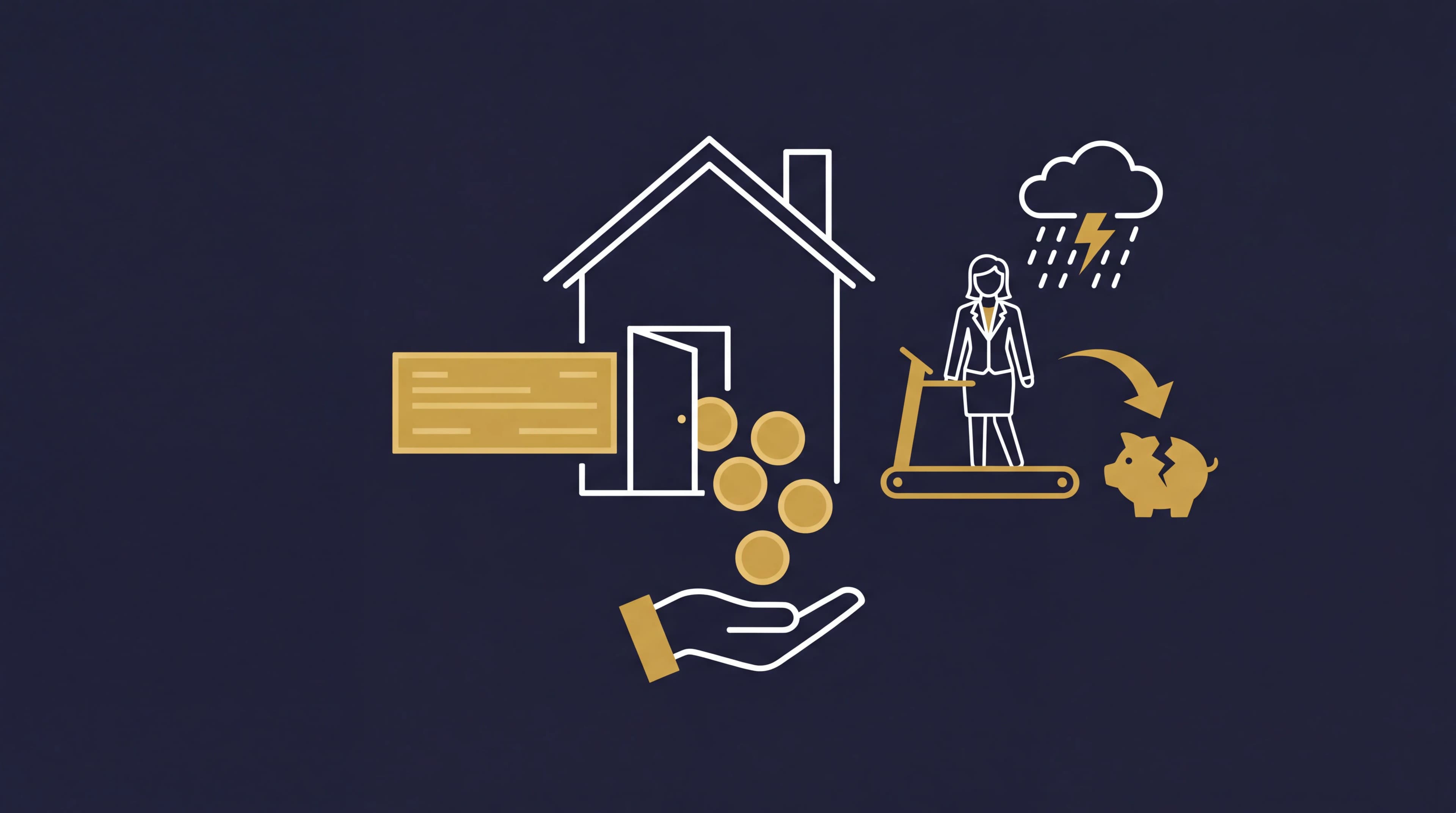
Why Middle-Income Millennials Live Paycheck to Paycheck
You followed the standard advice. You went to college, landed a professional job, and worked your way up to a salary that sounds perfectly respectable on paper. By traditional standards, you did everything right. Yet when you check your bank account the day before payday, the balance is uncomfortably close to zero.
Why are middle-income millennials living paycheck to paycheck? The answer is a structural math problem: the cost of a basic life—especially housing and childcare—has outpaced median earnings, while the long shadow of high-interest debt continues to drag down monthly cash flow.
If this sounds familiar, you are not alone. A massive share of middle-income millennials are currently living paycheck to paycheck. [Paycheck to paycheck] — [a financial state where an individual's entire income is spent on basic living expenses, leaving no money for savings or emergencies.] They feel like a single missed week of work, an unexpected medical bill, or a sudden rent increase could send their finances into a tailspin.
This creates a frustrating paradox. You earn what should be a comfortable income, yet you feel persistently fragile. This is not a personal failure, and it is certainly not because you buy too many coffees. Let us look at the real numbers behind this squeeze, why middle-income earners are struggling, and what you can do to protect yourself.
The Paycheck to Paycheck Reality Check
The reality of living paycheck to paycheck depends heavily on whether you measure bank balances or financial anxiety. When we talk about this financial squeeze, the numbers can be confusing depending on who is doing the asking.
If you look at bank accounts directly, the data tells one story. According to the Bank of America Institute (2025), nearly 24% of U.S. households are living paycheck to paycheck. They define this as households that typically run their checking balances down close to zero by the end of each pay period. While that number is high, it suggests that only about one in four households is entirely out of cash before payday.
However, when you ask people how they actually feel about their money, the picture gets much darker. According to ACA International (2024), about 65% of U.S. consumers said they were living paycheck to paycheck. According to Investopedia (2025), a recent financial wellness study reported an even higher figure of 67%.
Why is there such a massive gap between the bank data and the survey data? The answer lies in the feeling of financial margin. You might have a few hundred dollars left in your checking account on payday, keeping you out of the Bank of America statistic. But if you know that money is already spoken for by next month's rent, a looming credit card bill, or a student loan payment, you still feel the stress.
For millennials in their late twenties through early forties, this tension is constant. You might be in your peak earning years, but you are also in your peak expense years. Learning how to manage financial anxiety becomes essential when your objective income label says you are middle class, but your lived reality feels like you are barely scraping by.
The bottom line: Even if you have a few dollars left on payday, the mental weight of looming bills makes you feel entirely broke.
The Middle-Class Affordability Gap
Earning a middle-class income no longer guarantees you can afford a middle-class lifestyle in your city. Being middle class by income used to mean you could easily afford the basics, but that is no longer a guarantee.
Recent analysis looked at affordability for the American middle class using recent data. According to the Brookings Institution (2023), roughly one-third of middle-class households cannot afford the cost of basic necessities where they live. This calculation accounts for local prices of housing, transportation, healthcare, and other essentials.
The data gets even more alarming when you zoom in on major cities. According to the Brookings Institution (2023), in every major metro area examined, at least 20% of households defined as middle class by income fall short of what is needed for a basic standard of living. In some cities, that number reaches as high as 57%.
This hits millennials particularly hard. This generation is heavily concentrated in large, economically dynamic, but highly expensive metro areas. You might earn a combined household income of $90,000 to $120,000. On a national chart, that looks fantastic. But if you live in a major coastal city, your local cost structure eats that income alive.
These structural pressures are also unequal. The Brookings study found that middle-class families of color are more likely to be priced out of basic necessities than their white counterparts. This reflects deeper systemic issues, including differences in generational wealth and exposure to higher-cost housing.
Here's what this means: Your salary might look fantastic on a national chart, but local housing and living costs can easily render you middle class in name only.
The True Cost of a Basic Life
The purchasing power of the typical millennial worker is shrinking as the cost of core necessities outpaces wage growth. To understand where the money is going, we have to look at the rising floor of basic expenses.
The Ludwig Institute for Shared Economic Prosperity tracks this through two measures. [True Living Cost index] — [an economic measure that estimates the price of core necessities like housing, food, and healthcare.] [Minimal Quality of Life index] — [an economic measure that adds the costs associated with well-being and long-term mobility to basic necessities.]
According to the Ludwig Institute for Shared Economic Prosperity (2024), both of these indexes increased by about 4.4%. Median weekly earnings for full-time workers only rose 3.9%. This means the purchasing power of the typical worker actually shrank. Wages simply are not keeping pace with the cost of maintaining a baseline standard of living.
The specific categories driving this squeeze are exactly the ones millennials need most. In 2024, the housing component of the True Living Cost index jumped by 10.6%. Childcare costs rose by 7.7%, marking the largest increase on record. Healthcare has also been quietly draining budgets, increasing at an average annual rate of 4.9% since 2001.
When you add these basics up, the numbers are daunting. According to the Ludwig Institute for Shared Economic Prosperity (2024), the annual cost of maintaining a minimal quality of life is about $47,100 for a single adult and a staggering $121,100 for a couple with two children.
If your household income hovers around these numbers, you are doing exactly what is required just to survive. There is very little room left for aggressive debt repayment, saving for retirement, or taking a vacation. Taking the time to build your first budget can help you track these numbers, but a budget cannot magically lower your rent or childcare costs.
The bottom line: You are likely spending all your income just to survive, leaving virtually no room for aggressive debt repayment or retirement savings.
Everyday Expenses Keep Climbing
While extreme inflation has cooled, the baseline prices for everyday goods and utilities have permanently shifted upward. The extreme inflation of 2021 and 2022 has settled, but the damage remains.
According to the Bureau of Labor Statistics (2025), the Consumer Price Index rose 3.0% for the 12 months ending September 2025. But this current rate masks the cumulative damage done over the past few years. According to the U.S. Department of Agriculture (2024), food prices rose a massive 23.6% from 2020 to 2024.
Your grocery bill is permanently higher. Your utility bills have spiked, with natural gas prices jumping 11.7% and electricity costs rising 5.1% in the past year alone.
The Disproportionate Housing Burden on Millennials
The average American household now spends roughly $78,535 per year, or about $6,545 per month, on total expenses. Housing consumes about 33% of the typical household budget. If you are a single millennial, you spend less in absolute terms than a family, but more per person because you do not get to split the fixed costs of rent and utilities.
According to Michael Foguth (2025), the typical millennial individual takes home about $4,500 to $5,000 a month. According to NerdWallet (2025), housing, transportation, and food consume 48% of household income on average. For millennials specifically, housing takes up about 24.5% of income, much higher than the 21.6% share experienced by older Gen X households.
Here's what this means: When half of your take-home pay vanishes instantly to keep a roof over your head and food in the fridge, your margin for financial error disappears.
The Debt Anchor We Drag Behind Us
Heavy reliance on student loans and high-interest credit cards acts as a massive anchor on millennial cash flow. You cannot talk about millennial finances without talking about debt. This is the first generation to enter adulthood with widespread, heavy reliance on student loans.
According to EducationData.org (2025), about 11 million millennials currently have outstanding student loan debt, representing 35.1% of all student loan borrowers. While baby boomers actually hold higher average balances, millennials are in their prime working and family-forming years. A $400 or $500 monthly student loan payment is a massive drain on cash flow just when you need it most to buy a home or pay for daycare.
The Vicious Cycle of Credit Card Interest
Then comes the credit card debt. According to Experian (2025), millennials now carry an average credit card balance of $6,961. This is slightly higher than the average balance carried by baby boomers.
What makes this credit card debt so punishing is the cost of borrowing. Credit card annual percentage rates are now averaging around 22%. If you carry a $7,000 balance at 22% interest, you are paying over $1,500 a year just in interest charges. That is money that cannot go toward an emergency fund or retirement.
Student loans and credit cards often create a vicious cycle. You use credit cards to cover basic bills because your paycheck is eaten up by student loans and high rent. Eventually, the minimum payments on the credit cards grow so large that they consume whatever small margin you had left.
The bottom line: High-interest debt creates a vicious cycle where your paycheck is eaten by past obligations, forcing you to rely on even more credit to cover today's basic bills.
The Emergency Savings Deficit
Living paycheck to paycheck leaves millennials with no financial buffer to absorb the inevitable shocks of normal life. When you live paycheck to paycheck, you have no buffer. Cars break down. Pets get sick. Companies lay people off.
According to the Federal Reserve (2024), roughly one-third of adults report they would have difficulty covering a $400 emergency expense with cash or its equivalent.
When you are simultaneously managing rent, childcare, student loans, and credit card debt, building an emergency fund feels impossible. But without one, every minor inconvenience becomes a financial crisis that requires taking on more high-interest debt. Learning how to build a $1,000 emergency fund is a practical starting point, but it requires finding extra cash in a budget that is already stretched tight.
A lack of financial knowledge early in life also compounds this problem. According to Experian (2024), 70% of millennials felt their limited understanding of personal finance had led them to make costly mistakes. For 38% of millennials, those mistakes cost them $5,000 or more.
Whether it was misunderstanding how credit card interest accrues, taking out too many student loans, or missing out on employer retirement matches, these past mistakes act as an anchor on your current finances. You might make a good salary today, but you are using it to pay for the financial missteps of your twenties.
Here's what this means: Without an emergency fund, every minor inconvenience becomes a financial crisis that pushes you further into debt.
Common Questions
Why are millennials struggling financially despite having good jobs?
Millennials are struggling because the cost of basic necessities, especially housing and childcare, has outpaced wage growth. Even with a good salary, high fixed costs and lingering student loan debt consume most of their monthly take-home pay.
What percentage of millennials live paycheck to paycheck?
According to recent consumer surveys, approximately 65% to 67% of U.S. consumers report living paycheck to paycheck. While bank data shows fewer people hitting absolute zero, the feeling of financial fragility among middle-income millennials is widespread.
How can middle-income earners stop living paycheck to paycheck?
To stop living paycheck to paycheck, middle-income earners must actively lower their largest fixed costs, such as housing, transportation, and debt. Consolidating high-interest credit cards or negotiating rent can free up the cash flow needed to build an emergency buffer.
When will the cost of living go down for millennials?
While inflation rates have cooled, the baseline prices for everyday goods, housing, and utilities have permanently shifted upward and are unlikely to drop significantly. Millennials must focus on increasing their income and optimizing their fixed expenses rather than waiting for prices to fall.
Your One Next Step
If you are earning a middle-class salary but feeling completely squeezed, you cannot just budget your way out of structural economic problems. You have to actively lower your fixed costs to create breathing room.
Your next step is to audit your three largest expenses: housing, transportation, and debt. Pick just one category this week. Can you negotiate your rent or plan a move to a slightly cheaper neighborhood when your lease is up? Can you switch to a lower-cost car insurance provider? Can you consolidate your credit card debt to a 0% balance transfer card to stop the bleeding on interest?
You do not need to fix everything today. You just need to find one area where you can reclaim a small piece of your paycheck.
Your Money. Your Terms.
Get the 2026 Wealth Starter Kit
Free spreadsheet budget models and 2026 tax deduction checklists. The Money Edit is a weekly email with our newest practical money guides. No spam, no hype.
We respect your privacy. No spam, and we never sell your data. Read our Privacy Policy.

Sammy Dynamo
Software Engineer | CS Student | Technopreneur, Dyxium Inc
Related Articles

12 min read
BudgetingAlign Bill Due Dates With Your Paycheck: The Budget Pivot
Learn how to align bill due dates with your paycheck to eliminate late fees and fix...
Sammy Dynamo
10 min read
BudgetingDynamic Budgeting: Adjusting When Rent and Gas Spike
Dynamic budgeting helps you adapt when rent and gas prices spike. Learn how to adjust your...
Sammy Dynamo
12 min read
BudgetingLease Renewal Math: Accept a Rent Hike or Move in 2026?
Facing a rent hike? Use this lease renewal math to decide if you should stay or...
Sammy Dynamo