Cash vs Investing in 2026: When to Pause
Cash vs Investing in 2026: When to Pause
You log into your investment account and see your balance slowly climbing. It feels great. You want to throw every spare dollar into the market to keep that momentum going. Then, your car makes a terrible grinding noise on the highway. Or maybe rumors of layoffs start circulating at your office. Suddenly, having all your money locked away in a retirement account feels a lot less comforting.
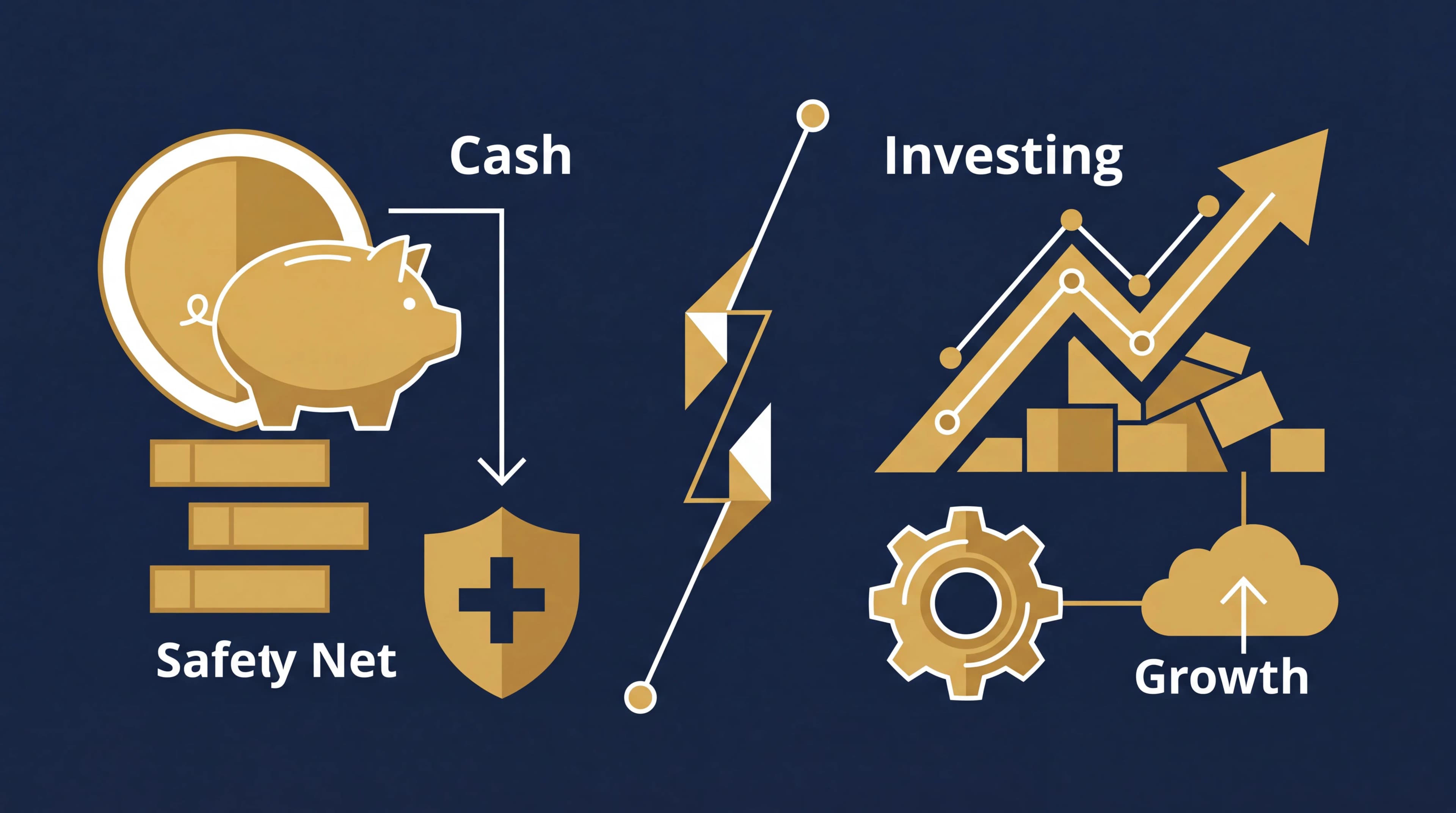
Deciding whether to pause your long-term investments to build a larger cash safety net is a common financial conflict. Should you pause contributions to build a bigger safety net? Yes, if you lack a basic emergency fund, carry high-interest debt, or have unstable income, pausing investments to stockpile cash is the right move. It sits right at the intersection of math, the economy, and human psychology.
Prices are higher today. Job markets are shifting, and expenses are unpredictable. Because of this, many young professionals wonder if they should temporarily stop investing to pile up cash. The answer isn't a simple yes or no. It depends heavily on your current stability and how much risk you carry in your daily life.
The Reality of Emergency Savings Right Now
A massive portion of the population is currently operating without a financial safety net. If you feel like you don't have enough cash on hand, you aren't alone. Recent data shows that building a cash buffer is a widespread struggle.
According to Bankrate (2025), nearly a quarter of Americans (24 percent) have absolutely no emergency savings. Even among those who do save, only 46 percent report having enough cash to cover three months of living expenses. This lack of cash takes a mental toll. In fact, 60 percent of adults say they are uncomfortable with their current level of emergency savings.
According to the Federal Reserve (2024), 63 percent of adults could cover a hypothetical $400 emergency using cash or its equivalent. However, a concerning 36 percent would struggle to pay for such a minor unexpected expense.
When you look at these numbers, it becomes clear why the cash versus investing debate is so critical. Investing is how you build wealth over decades. Cash is how you survive the week.
The bottom line: Most Americans lack sufficient cash reserves, making the choice to prioritize emergency savings over investing a necessary reality for many.
Why Cash Feels Different in 2026
Several economic factors make holding cash essential in 2026. The decision to hold cash is complicated right now, driven by shifting costs and employment trends.
First, the cost of living remains noticeably higher than it was a few years ago. Inflation — the rate at which the general level of prices for goods and services rises — has cooled down from its peaks, but the total increase in prices is permanent. According to the Bureau of Labor Statistics (2024), the rising cost of housing, food, transportation, and medical care leaves many households feeling financially squeezed.
Because prices are higher, your emergency fund target has to be higher too. Three months of expenses today requires a much larger dollar amount than it did five years ago. This makes the finish line feel further away. It can even tempt you to give up on saving cash entirely and just throw your money into the stock market instead.
Second, job security is uneven. The national unemployment rate has hovered near historic lows in the 3.5 to 4 percent range. But younger workers are often concentrated in sectors with higher turnover and contract volatility. If you work in the gig economy, early-stage tech, or hospitality, a low national unemployment rate doesn't protect you from losing your specific income stream.
This combination of higher daily costs and uneven job stability is a strong argument for building a larger cash buffer. If you are starting from scratch, learning how to build a $1,000 emergency fund from scratch is the best first step you can take to protect yourself from these economic shifts.
Here's what this means: Higher living costs and unpredictable job markets mean your emergency fund target must be larger today than it was five years ago.
The Psychological Power of a Cash Buffer
Emergency savings fundamentally improve your mental health and financial decision-making. We often treat money like a math problem, but it's largely a psychological one. Emergency savings do more than just pay for broken water heaters. They fundamentally change how you feel and behave.
According to Vanguard (2024), households with at least $2,000 in accessible savings reported a 21 percent increase in overall financial well-being. These individuals experienced significantly lower levels of financial stress. They also spent fewer hours each week worrying about money compared to those with zero savings.
This psychological safety translates directly into better decision-making. When you aren't stressed about how to pay for next week's groceries, you are far less likely to make impulsive choices. People with adequate cash buffers don't resort to predatory payday loans. They don't max out high-interest credit cards for basic needs. Most importantly for your long-term goals, they don't panic and sell their investments at a loss when the stock market dips.
If you struggle with money stress, building a cash reserve is one of the most effective ways to manage financial anxiety during uncertain times. Knowing you can handle a crisis brings serious peace of mind. This feeling is often worth more than the potential returns you might miss by pausing your investments for a few months.
The bottom line: A cash buffer provides psychological safety that prevents costly, panic-driven financial mistakes.
The Hidden Cost of Pausing Your Investments
Pausing your investments guarantees a loss of purchasing power and compound interest. While cash provides security, it comes with a major downside. Cash loses its purchasing power over time due to inflation.
Historically, broad U.S. stock market indexes like the S&P 500 generate average annual total returns around 9 to 10 percent over multi-decade periods. By contrast, even the best savings accounts yield only a fraction of that. Traditional bank accounts pay virtually nothing.
When you pause your investments to build cash, you make a deliberate tradeoff. You are trading long-term growth for short-term certainty. If you pause your contributions for a year, you aren't just missing out on the money you would have invested. You are missing out on decades of compound interest — the interest you earn on both your original money and on the interest it has already accumulated — on those specific dollars.
On top of that, according to Gallup (2024), many investors expect continued volatility in the stock market but remain broadly confident in equities for retirement. If you sit on the sidelines for too long trying to build a massive cash pile, you risk missing the best days of market performance.
This is why traditional financial advice usually recommends a balance. You need enough cash to prevent disaster, but you need to invest enough to secure your future. So, how do you know when to hit pause?
Here's what this means: Holding too much cash trades long-term wealth growth for short-term certainty, so you must balance safety with investing.
When You Should Pause Investing to Build Cash
There are specific scenarios where pausing your investments to stockpile cash isn't just acceptable, it is mathematically and practically necessary.
You Have Zero Emergency Savings
If you are part of the 24 percent of Americans with absolutely no cash buffer, you are walking a financial tightrope. Even a minor disruption (like a flat tire or a sick pet) will force you into debt. In this scenario, pausing your investments to build a starter emergency fund of one month of expenses is a smart, defensive move.
You Are Drowning in High-Interest Debt
According to Bankrate (2026), 29 percent of people have more credit card debt than emergency savings. If you are paying 24 percent interest on a credit card balance, investing in the stock market to chase a 9 percent return makes no sense. You are losing money on the spread. Pause your investments, build a small cash buffer, and aggressively pay down that toxic debt.
Your Income is Highly Unstable
If you are a freelancer, a contractor, or work in an industry experiencing massive layoffs, cash is your best friend. The standard advice of keeping three months of expenses in savings might not be enough for you. You may need six to nine months of cash to feel secure. Pausing investments to reach this larger target is a reasonable way to manage your career risk.
Before you put another dollar into the market, make sure you have established a proper financial safety net before investing. You can't build a stable financial house on a shaky foundation.
The bottom line: Pause your investments if you lack a basic emergency fund, carry high-interest debt, or face severe income instability.
When You Should Keep Investing (And Build Cash Slowly)
On the flip side, there are times when pausing your investments could be a costly mistake. You should strive to keep investing while slowly building your cash buffer if the following apply to you.
You Get an Employer Match on Your Retirement Account
If your employer offers a 401(k) match, that is free money. It's a 100 percent guaranteed return on your investment. You should do everything in your power to contribute enough to get that full match. Yes, even if it means your emergency fund grows a little slower. Never pause the match unless you can't afford basic food and shelter.
You Already Have a Basic Safety Net
If you have $2,000 to $3,000 in the bank, you already hit the threshold Vanguard identifies as the turning point for financial well-being. You may eventually want a full three to six months of expenses saved. However, you don't need to pause your investments completely to get there. You can split your extra money each month, sending half to your investments and half to your savings account.
Your Job and Living Situation Are Highly Stable
If you have a secure salary, excellent health insurance, and predictable living expenses, your risk of a catastrophic financial shock is lower. You can afford to carry a slightly smaller emergency fund and keep your focus on long-term wealth building.
Here's what this means: If you have a starter emergency fund, stable income, or an employer match, keep investing while gradually adding to your cash reserves.
Where to Keep Your Safety Net
High-yield savings accounts are the best place to store your emergency cash. If you decide to pause your investments to build cash, you need to put that money in the right place.
For a safety net, "cash" means highly liquid money that is protected from market drops. According to Gallup (2024), 42 percent of investors prefer to keep their emergency funds in simple savings accounts. This makes sense because liquidity and simplicity are exactly what you need in a crisis.
But not all savings accounts are created equal. According to the FDIC (2024), average interest rates at traditional brick-and-mortar banks remain incredibly low. If you leave your emergency fund at a traditional bank, inflation will eat away at its value every single day.
Instead, look for High-Yield Savings Accounts (HYSAs) offered by online banks. HYSAs — deposit accounts that pay significantly higher interest rates than traditional bank accounts while maintaining FDIC insurance — give you the exact same protection and immediate access to your money. You can also consider money market deposit accounts. Your emergency fund will never beat inflation completely, but a good HYSA ensures it puts up a decent fight.
The goal of this money isn't to make you wealthy. The goal of this money is to protect the money that will make you wealthy.
The bottom line: Keep your emergency fund in a high-yield savings account to maintain liquidity while fighting off inflation.
Common Questions
Why should I choose cash vs investing in 2026?
You should choose cash over investing in 2026 if you do not have an emergency fund, carry high-interest debt, or have an unstable income. Building a cash safety net protects you from unexpected expenses and prevents you from going into debt during economic shifts. Once your safety net is secure, you can confidently resume investing.
How much cash should I save before I start investing?
You should save enough cash to cover three to six months of essential living expenses before heavily investing. However, if you are just starting out, building a $1,000 to $2,000 starter emergency fund is a great initial milestone. This basic buffer provides enough financial security to begin investing while you slowly grow your cash reserves.
What happens if I pause my 401(k) contributions?
If you pause your 401(k) contributions, you will miss out on potential market growth and the power of compound interest. More importantly, you will lose any employer match, which is essentially free money. You should only pause your 401(k) if you are facing a severe financial hardship or lack a basic starter emergency fund.
When is the best time to resume investing after building a safety net?
The best time to resume investing is immediately after you hit your target emergency fund balance and have paid off any high-interest debt. You do not need to wait for perfect market conditions to start contributing again. Consistency in the market is more important than timing, so turn your automatic investments back on as soon as your cash buffer is secure.
Your One Next Step
Open your banking app and look at your current savings balance. Next, calculate your bare-bones survival number for one month (rent, groceries, utilities, basic insurance). If your savings balance is lower than your one-month survival number, log into your investment accounts. Temporarily pause your automatic contributions. Redirect that exact dollar amount into a high-yield savings account until you hit that one-month milestone. Once you reach it, you can turn your investments back on and breathe a lot easier.
Your Money. Your Terms.
Listen to this article
AI-generated audio · Voices by ElevenLabs
Get smarter about money
One practical tip per week. No spam, no hype — just clear steps toward financial progress.

Sammy Dynamo
Software Engineer | CS Student | Technopreneur, Dyxium Inc
Related Articles
12 min read
Saving & InvestingFinancial Order of Operations: First Paycheck Guide
Master your money with this 2026 financial order of operations. Discover exactly where to route your...
Sammy Dynamo
11 min read
Saving & InvestingHSA in 2026: Why the Standard Money Flowchart is Wrong
The standard money flowchart puts your HSA at the bottom. Discover why rising health costs mean...
Sammy Dynamo
12 min read
Saving & Investing2026 Cash Ladder: Combine HYSAs, T-Bills, and I Bonds
Learn how to build a 2026 cash ladder using HYSAs, T-Bills, and I Bonds. Maximize your...
Sammy Dynamo