The $5-$20 Daily Habit Costing You $1,825–$7,300 Per Year (And How to Actually Stop)
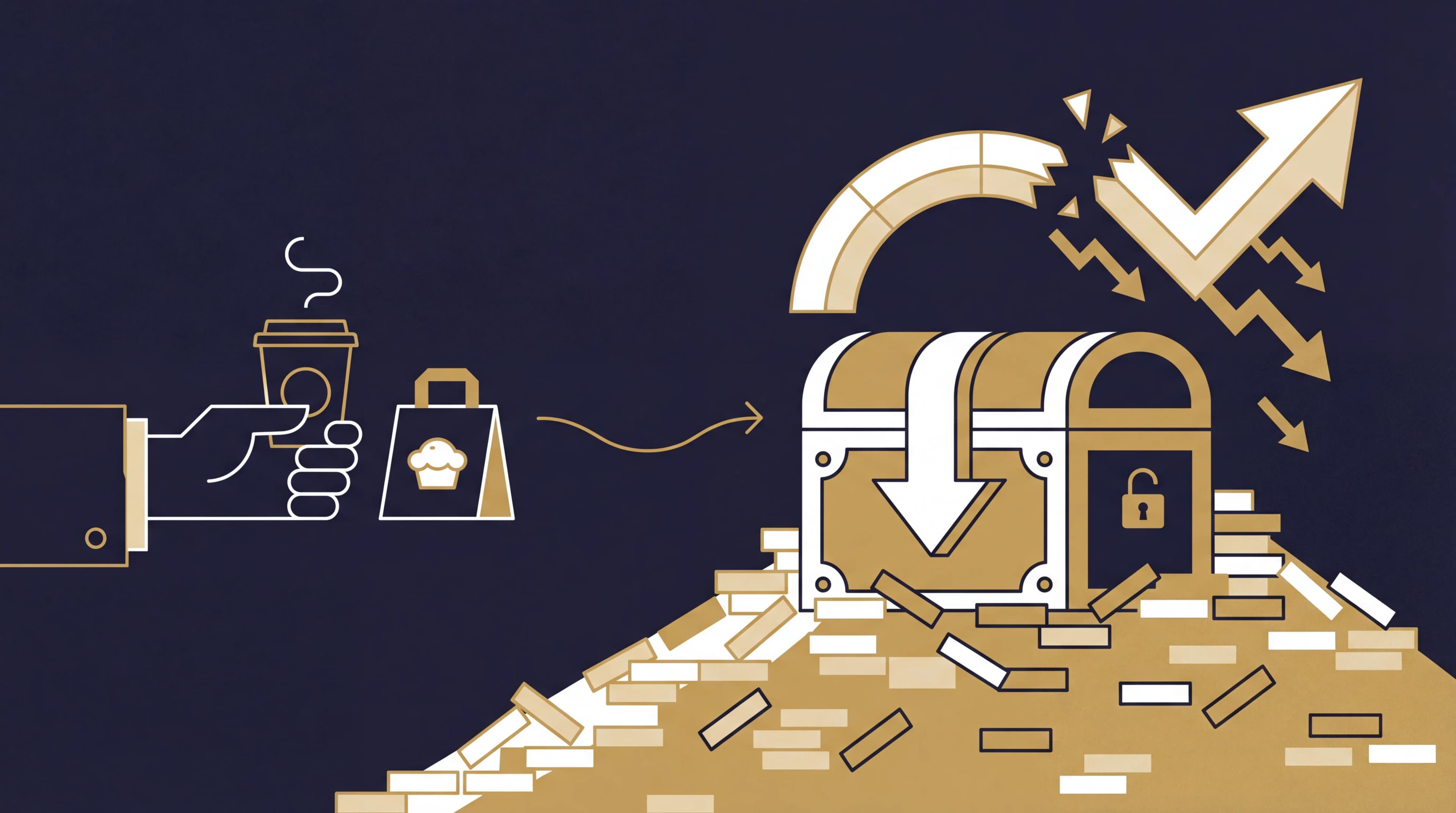
The $5-$20 Daily Habit Costing You $1,825–$7,300 Per Year (And How to Actually Stop)
You grab a coffee on the way to work. You pay a small delivery fee for lunch because you forgot to pack one. You tap your phone to rent a movie on a Tuesday night. None of these choices feel like major financial decisions. They are just the normal background noise of modern life.
But when you run the numbers, the math becomes impossible to ignore. Spending just five to twenty dollars a day on minor conveniences adds up to between $1,825 and $7,300 over the course of a single year.
For most of us, that is not pocket change. That is a vacation, a massive contribution to an emergency fund, or a few months of rent.
This daily drain is often called the "Latte Factor," but the reality is much bigger than coffee. We are living in an era where spending money is frictionless. Between food delivery apps, unused subscriptions, and one-click checkouts, our money slips away in tiny increments.
If you feel like you make a decent income but never seem to have much left over at the end of the month, you are not alone. Let us look at exactly where this money goes, why it is so hard to stop spending it, and how you can take back control without making your life miserable.
The Hidden Math of Modern Convenience
To understand why small daily spending matters so much, we have to look at the big picture of an average budget.
According to the Federal Reserve's 2024 Report on Economic Well-Being, Americans put about 83.7 cents of every dollar toward just five essential categories. Those are housing, transportation, food, insurance, and healthcare. That leaves only 16.3 cents of every dollar for discretionary spending.
When your flexible money is already that tight, a twenty-dollar daily habit takes a massive bite out of your financial security.
The problem is that the modern economy is built to extract those remaining dollars through convenience. Research from the Groundwork Collaborative calls this the "annoyance economy." They estimate that hidden fees, complicated business practices, and wasteful spending patterns cost Americans approximately $165 billion every year.
You can see this clearly in specific categories. The average American now spends $118 a month on food delivery apps alone, which totals $1,416 a year. We also spend an average of $191 per person each month on dining out. Interestingly, data shows that average order values through delivery apps are about 32 percent higher than regular dine-in transactions. When you are browsing a menu from your couch, it is simply too easy to add an extra side dish or a dessert.
Why We Fall for the Convenience Trap
It is easy to beat yourself up over these habits, but you should know that your brain is actively working against you.
Behavioral economists point to something called the "ease of purchase problem." In the past, buying something required friction. You had to drive to a store, walk the aisles, pull cash out of your wallet, and physically hand it to a cashier. Every step gave your brain time to ask if the purchase was really worth it.
Today, digital commerce has reduced that friction to zero. With saved payment methods and mobile wallets, buying is nearly instantaneous. You do not have time to think.
Emotions also play a massive role. We frequently use small purchases to cope with stress, boredom, or anxiety. Research by Wendy De La Rosa at the Wharton School shows that how wealthy we feel in comparison to our peers predicts our spending behavior more accurately than our actual bank account balance. If you feel stressed after seeing a coworker's new car, you are much more likely to treat yourself to an expensive takeout meal to boost your mood.
This is especially true for younger adults. A recent Bank of America Institute report found that 72 percent of Gen Z took steps to improve their financial health over the past year. Yet, 59 percent of them admit that buying small weekly "treats" consistently leads to overspending. We know we are doing it, but the emotional payoff in the moment overrides our long-term goals.
The Silent Drain of Forgotten Subscriptions
Subscriptions deserve their own spotlight because they are the ultimate form of automated convenience spending.
According to a survey by The Motley Fool, Americans spend an average of $1,100 a year on subscription products. These range from streaming video to meal kits to fitness apps. The shocking part is that consumers admit about $200 of that annual spending goes toward services they rarely or never use.
Why do we keep paying for things we do not use? It comes down to two psychological traps.
First is the "out of sight, out of mind" phenomenon. Because the payment happens automatically in the background, it bypasses your normal decision-making process.
Second is the sunk cost fallacy. When we have already invested money into a fitness app or a streaming service, we feel like canceling it means admitting defeat. We tell ourselves we will use it next week. Meanwhile, the companies intentionally make the cancellation process complicated to keep you paying. The Groundwork Collaborative report notes that making cancellation difficult can increase corporate revenues by more than 200 percent.
The Real Price Tag (Understanding Opportunity Cost)
The true cost of a daily convenience habit is not just the money you spent. It is the money that money could have made for you. In finance, this is called opportunity cost.
Let us say you manage to cut just $10 a day from your convenience spending. That is $3,650 a year.
If you were to take that money and invest it at a conservative 5 percent annual return, it would grow to roughly $18,882 over ten years. Over twenty years, the opportunity cost of that daily ten-dollar habit exceeds $100,000.
When you frame a daily purchase this way, it changes your perspective. You are not just buying a ten-dollar lunch. You are trading away a piece of your future financial freedom. This is why learning to start investing even a small amount makes such a profound difference in your life. The math of compound interest works identically whether you are building wealth or draining it.
How to Change Your Habits Without Guilt
The worst way to fix convenience spending is to swear off all fun, delete every app, and promise to never buy a coffee again. Extreme restriction almost always leads to a spending binge later.
Instead, the goal is to practice financial mindfulness.
Researchers at Georgetown's McDonough School of Business found that people with high financial mindfulness have measurably higher credit scores and lower debt. They define this mindfulness as having two parts. The first is awareness (knowing what you spend). The second is acceptance (looking at your finances without shame or judgment).
When you look at your credit card statement and feel deeply guilty about your food delivery habits, your instinct is to close the app and avoid thinking about it. That avoidance keeps you trapped. But when you can look at your spending neutrally, you regain the power to change it.
You can absolutely spend less without feeling deprived if you align your spending with what actually brings you joy. If a daily coffee from a local cafe genuinely improves your morning, keep it. Just make sure you cut costs ruthlessly in areas that do not matter to you.
Practical Rules for Mindful Spending
If you want to stop the slow leak of convenience spending, you need practical systems that do the heavy lifting for you. Here are four strategies that actually work.
1. Enforce a 24-Hour Waiting Period
Impulse buying thrives on speed. You can short-circuit this by creating mandatory friction. Whenever you want to buy something that is not a planned essential, force yourself to wait twenty-four hours. Leave the item in your digital cart. Close the app. If you still want it the next day and it fits your budget, buy it. Most of the time, the emotional urge will fade and you will gladly keep your money.
2. Do a Ruthless Subscription Audit
Set a calendar reminder for this weekend. Sit down with your last two months of bank and credit card statements. Highlight every recurring charge. If you have not used a service in the last thirty days, cancel it immediately. Do not tell yourself you will use it eventually. If you actually miss it, you can always sign up again later.
3. Delete Your Saved Payment Methods
Online retailers and delivery apps want your credit card saved on file because it makes spending painless. Take ten minutes to go into your most frequently used apps and delete your saved cards. Force yourself to get up, find your wallet, and manually type in your card number every time you want to buy something. That tiny bit of physical effort is often enough to stop a mindless purchase.
4. Build a Budget With "Fun Money"
You need a system that gives you permission to spend. The 50/30/20 framework is a great place to start. You put 50 percent toward needs, 20 percent toward savings, and 30 percent toward wants. By explicitly setting aside money for conveniences, you remove the guilt. If you want to know how to set this up quickly, you can build your first budget in under thirty minutes.
Your One Next Step
Reading about spending habits is easy, but taking action is what actually changes your bank balance. Your next step is simple. Open your phone right now, find one recurring subscription you have not used in the last month, and cancel it. It will take less than two minutes, and you will instantly put money back into your pocket for the rest of the year.
Your Money. Your Terms.
Listen to this article
Get smarter about money
One practical tip per week. No spam, no hype — just clear steps toward financial progress.

Sammy Dynamo
Software Engineer | CS Student | Technopreneur, Dyxium Inc
Related Articles
10 min read
Mindful Spending2026 Car Tax Deduction: A Math Reality Check
Thinking of buying a car for the 2026 tax deduction? With average ownership costs hitting $12,297...
Sammy Dynamo
11 min read
Mindful SpendingCost of Raising a Child in 2026: A Financial Guide
The cost of raising a child in 2026 exceeds $303,000. Discover where the money goes and...
Sammy Dynamo
13 min read
Mindful SpendingSaying No to Expensive Weddings: Money Boundaries
Struggling with the cost of being a guest? Learn how saying no to expensive weddings and...
Sammy Dynamo