Startup Stock Options: Why They’re a Trap & What to Do
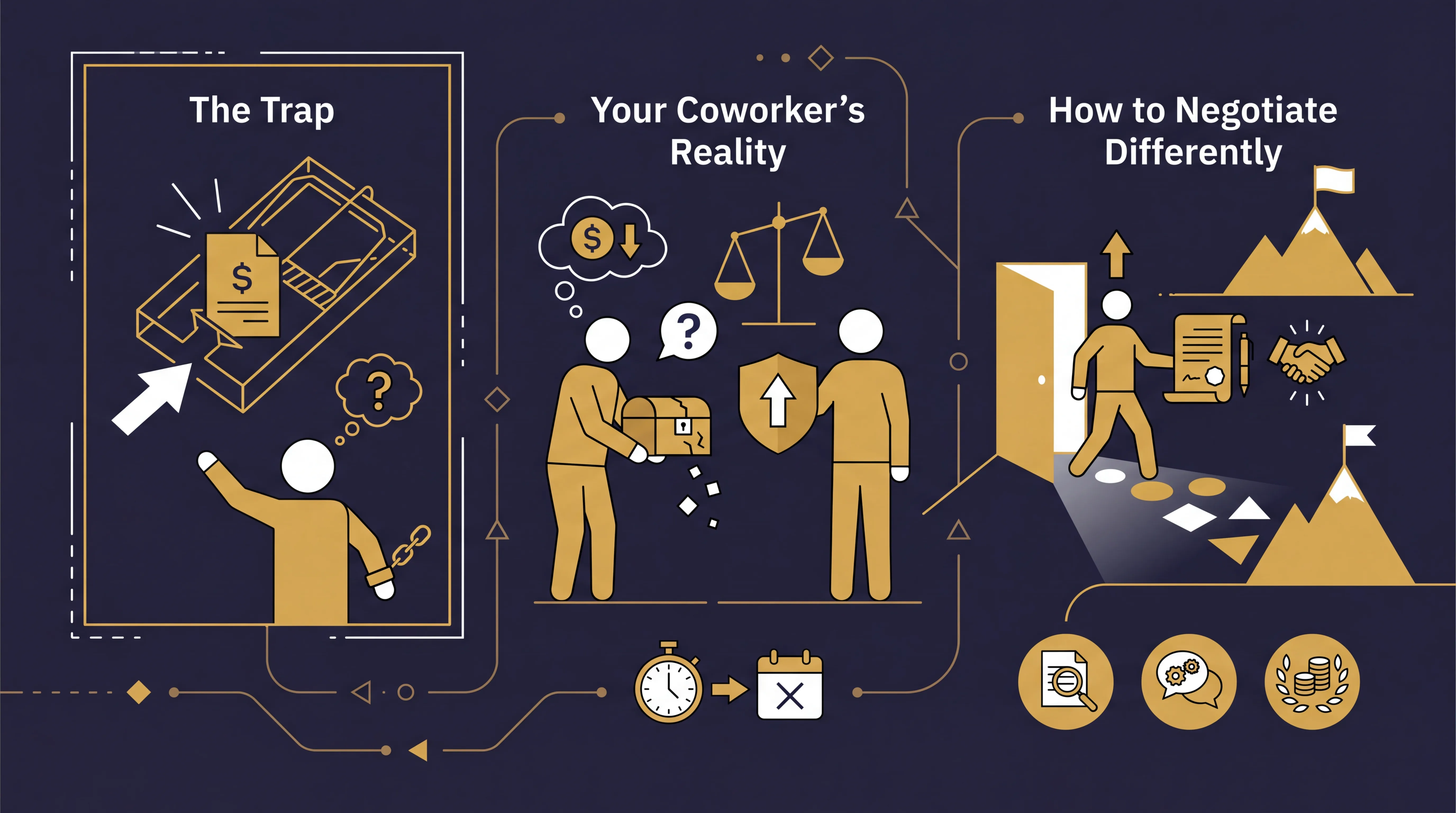
Your coworker just casually mentioned they received 50,000 stock options in their new compensation package. If you are sitting there with a standard salary and a 401(k), it is easy to feel like you are missing out. The tech industry has spent decades selling the story that equity is the guaranteed path to financial freedom.
The reality is much less glamorous. Why are startup stock options usually a trap? Because the high upfront costs to exercise shares, combined with massive tax bills and strict 90-day expiration windows, force most employees to abandon their equity entirely.
The data tells a surprisingly grim story about employee equity. Stock options remain a huge part of modern pay. But their structure creates major obstacles for anyone without significant savings. Let's look at why those 50,000 options might actually be worth zero. We will also cover the hidden costs that trap most employees and how you can negotiate a better deal.
The Math Problem Behind Startup Stock Options
Stock options are not free money; they are a highly restricted financial contract. When a company offers you stock options, they are not giving you shares. They are giving you the right to buy shares at a specific price at some point in the future. [Strike price — the fixed, predetermined price at which an employee can buy a share of company stock.] If the company grows and the share value increases, you can buy those shares at a discount. Theoretically, you can then sell them for a profit.
That is the theory. In practice, most employees never see a dime.
According to Carta (2024), startup employees exercised just 32.2% of all fully vested equity grants. This only counts options that were "in the money," meaning the current value was higher than the strike price. That is a historic low.
Why are people walking away from seemingly profitable shares? Carta analyzed 386 private companies valued over $1 billion. According to Carta (2022), nearly 50,000 workers walked away from fully vested stock options, abandoning a combined net value of over $1.8 billion. The average employee left more than $47,000 on the table.
People do not walk away from $47,000 because they want to. They walk away because the system makes it incredibly difficult to claim it.
The bottom line: The mathematical reality of startup equity is that high upfront costs and structural barriers force the average employee to abandon tens of thousands of dollars in vested shares.
The Double Tax Trap of Employee Equity
The primary reason exercise rates are so low is brutally simple: exercising options is prohibitively expensive.
Stock options require upfront cash that most young professionals simply do not have lying around. According to Secfi (2022), their average client needed approximately $846,000 to exercise their stock options and pay the associated taxes. Consider a mid-level employee earning $150,000 a year with a standard equity package. The cash required to exercise often exceeds their entire annual salary.
This happens because of a mechanism known as the "double bite." [Double bite — the dual financial burden of paying the strike price to buy shares, plus the immediate taxes owed on the phantom gain.]
First, you have to find the cash to buy the shares at your strike price. Second, and much more painfully, you have to pay taxes on the "phantom gain." [Phantom gain — the taxable difference between your strike price and the current higher valuation of the stock, even though you have not actually sold any shares.] Let's say you buy shares at $10 and the current valuation is $50. The IRS taxes that $40 difference. This counts as ordinary income for non-qualified stock options. For incentive stock options, it triggers the alternative minimum tax.
You have to pay this tax bill out of pocket. This happens even though you have not actually sold the shares and have no cash proceeds to show for it. If the company is still private, you cannot sell a portion of your shares to cover the tax bill. You just have to drain your savings to pay the IRS. Then you just hope the company eventually goes public or gets acquired.
Before you even consider taking a job that relies heavily on equity compensation, you need solid basic finances. Check out our guide on building a financial safety net before investing. This will help ensure you are not putting your livelihood at risk for a lottery ticket.
Here's what this means: You must pay massive out-of-pocket costs to the IRS for shares you cannot even sell yet, draining your personal savings for a theoretical future payout.
The 90-Day Post-Termination Exercise Period Trap
Leaving your job triggers a strict countdown that forces most employees to forfeit their hard-earned equity. The trap snaps shut entirely when you decide to change jobs.
Most companies enforce a post-termination exercise period (PTEP) of exactly 90 days. [Post-termination exercise period (PTEP) — the specific window of time, usually 90 days, an employee has to buy their vested options after leaving a company.] When you leave a company, whether you quit or get laid off, a timer starts. You have exactly three months to decide if you want to buy your vested options. If you do not buy them within that window, they disappear forever. They simply return to the company's equity pool.
This 90-day window creates a massive financial crisis for departing employees. You are likely transitioning between jobs. You might even be facing a period with zero income. Suddenly, you need to come up with tens of thousands of dollars. You need this cash to buy illiquid stock and pay the tax bill.
Major venture capital firms like A16Z have publicly acknowledged that this 90-day window creates genuine hardship. It forces employees to make a rushed, expensive investment decision. The only alternative is forfeiting the equity they spent years earning. If you are thinking about leaving a job where you hold options, you need a strategy. Read our career transition financial plan for quitting your job. It shows you how to prepare your finances before handing in your notice.
The bottom line: The 90-day window creates a manufactured financial crisis, forcing departing employees to either come up with tens of thousands of dollars immediately or lose their equity forever.
Why We Fall for the Equity Compensation Illusion
Behavioral psychology blinds employees to the severe mathematical risks of equity compensation. If the math is so bad, why do we keep accepting options in lieu of cash? The answer lies in behavioral finance.
Humans are wired for loss aversion. [Loss aversion — the psychological phenomenon where the pain of losing something feels twice as powerful as the pleasure of gaining it.] We hate missing out on potential gains. We also hate walking away from things we feel we have earned. When an employee receives options, they immediately start calculating future wealth. They imagine what those shares will be worth if the company becomes the next tech giant.
This optimism leads to dangerous concentration risk. According to Schwab (2023), company stock makes up over a quarter of the average employee's investment portfolio. Even worse, 21% of respondents did not even know how much of their portfolio was composed of company stock.
According to Secfi (2022), stock options comprise 86% of the average startup employee's total net worth. Tying your employment income and your investment portfolio to the exact same company is incredibly risky. If the company fails, you lose your job and your life savings on the same day.
Here's what this means: Tying your employment income and your investment portfolio to the exact same startup creates catastrophic concentration risk that can wipe out your net worth.
The Invisible Wall of Preferred Stock
Not all company shares are created equal, and employee shares are always at the bottom of the hierarchy. There is another structural reality that companies rarely explain to employees during the hiring process.
When venture capitalists invest in a startup, they receive preferred stock. [Preferred stock — a class of ownership given to investors that comes with special rights, including getting paid back before common shareholders.] When you receive options as an employee, you get common stock. [Common stock — the standard class of shares given to employees, which only pays out after all preferred investors have taken their cut.]
Preferred stock comes with special rights. The most important of these are liquidation preferences. [Liquidation preference — a contractual clause guaranteeing investors get their initial money back, or more, before anyone else gets a single penny during a sale.]
A standard liquidation preference protects the investors. If the company is sold, the investors get their initial money back before anyone else gets a single penny. Let's say a company raised $100 million from investors and eventually sells for $90 million. The investors take the entire $90 million. The founders and the employees holding common stock get absolutely nothing.
This "liquidation preference overhang" creates a harsh reality. Your options can be mathematically worthless even if the company is successfully acquired. You are always standing at the back of the line.
The bottom line: Because of liquidation preferences, your common stock options can be mathematically worthless even if the startup is successfully acquired for millions of dollars.
How to Negotiate Startup Equity Like a Professional
Understanding the traps of equity compensation allows you to negotiate terms that actually protect your financial interests. Understanding these traps does not mean you should reject equity entirely. It just means you need to negotiate it on your terms. You should treat it as a high-risk bonus rather than guaranteed salary.
When you are at the offer stage, rely on the exact same preparation you would use for cash compensation. Our guide on Gen Z salary negotiation strategies covers the fundamentals. However, equity requires a few specific tactics.
Ask for Percentages, Not Share Counts
An offer of 50,000 shares sounds amazing until you learn the company has one billion shares outstanding. Your 50,000 shares represent 0.005% of the company. Always ask for the total number of fully diluted shares outstanding. This allows you to calculate your actual ownership percentage.
According to SaaStr (2022), the median first hire receives 1.5% fully diluted equity, while the fifth hire receives just 0.33%. Knowing these benchmarks prevents you from being distracted by large, meaningless share counts.
Negotiate the Vesting Cliff
The standard vesting schedule is four years with a one-year "cliff." This means you get nothing if you leave before 12 months. You can negotiate this. Ask for a six-month cliff, or ask for monthly vesting from day one. This protects you if the role turns out to be a bad fit. It also helps if the company does early layoffs.
Ask for an Extended Exercise Window
The 90-day post-termination window is standard, but it is not a legal requirement for non-qualified stock options. You can ask the company to write an extended exercise window directly into your offer letter. Two to five years is a reasonable request. Some progressive companies like Pinterest and Carta are already doing this. If a company refuses, you know exactly how much risk you are taking on.
Here's what this means: You must treat equity as a high-risk bonus and aggressively negotiate the vesting schedule, exercise windows, and percentage ownership to mitigate your risk.
Evaluating the Base Salary vs. Stock Options Trade-Off
Accepting a lower base salary in exchange for more stock options is one of the most dangerous financial trade-offs an employee can make. The most common negotiation tactic employers use is offering a higher equity package in exchange for a lower base salary. You need to evaluate this trade-off with extreme caution.
Research from EquityBee shows that employees consistently underestimate the cost of these trade-offs. Let's look at the math. Imagine you accept a salary that is $10,000 below market rate in exchange for extra options. Over a four-year vesting schedule, you are giving up $40,000 in guaranteed cash.
To break even, those options do not just need to be worth $40,000. They need to be worth $40,000 plus the cost to exercise them and the taxes you will owe. You also have to factor in the return you could have earned by simply investing that $10,000 a year in an index fund.
On top of that, you have to actually stay at the company to get them. According to Carta (2023), the average startup employee stays at their company for just 2.0 years. If you leave after two years, you took a $20,000 pay cut. You also only walked away with half of your promised options. Then you only have 90 days to buy them.
Never take a salary reduction that impacts your ability to pay your bills. You still need to save for emergencies and hit your baseline financial goals. Equity should be the cherry on top of a fair market salary, not a replacement for it.
The bottom line: Never take a salary reduction that impacts your ability to pay bills or save for emergencies; equity should be the cherry on top of a fair market salary.
Common Questions About Startup Stock Options
What happens to my stock options if I quit?
If you quit your job, you typically have exactly 90 days to exercise your vested stock options. If you do not buy them within this post-termination exercise period, they expire and return to the company. You must have the cash ready to cover both the strike price and the resulting tax bill.
Why do employees walk away from vested stock options?
Employees walk away from vested stock options primarily because the upfront cost to exercise them is too high. Buying the shares and paying the immediate phantom gain taxes often requires more cash than the employee has in savings. As a result, billions of dollars in equity are abandoned every year.
How do I calculate the cost to exercise my options?
To calculate your exercise cost, multiply your total number of vested shares by your strike price. Next, you must calculate the estimated tax bill on the difference between your strike price and the current 409A valuation. Adding these two numbers together gives you the total out-of-pocket cost to claim your shares.
Can I negotiate my stock option vesting schedule?
Yes, you can and should negotiate your stock option vesting schedule during the initial job offer. While a four-year vest with a one-year cliff is standard, you can ask for a six-month cliff or monthly vesting from day one. This protects your equity if you leave the company early or face unexpected layoffs.
Your One Next Step
If you currently hold stock options, your next step is simple. Log into your company's equity portal (like Carta or Shareworks) today. Find your exact strike price, your number of vested shares, and the current 409A valuation of the company. Multiply your vested shares by your strike price. This shows exactly how much cash you would need to buy them if you quit tomorrow. Knowing that exact dollar amount is the first step to taking back control of your financial future.
Your Money. Your Terms.
Listen to this article
AI-generated audio · Voices by ElevenLabs
Get smarter about money
One practical tip per week. No spam, no hype — just clear steps toward financial progress.

Sammy Dynamo
Software Engineer | CS Student | Technopreneur, Dyxium Inc
Related Articles

12 min read
Personal DevelopmentWhat to Ask a Financial Advisor: A Young Pro’s Checklist
Not sure what to ask a financial advisor? From fees to fiduciary duty, use this checklist...
Sammy Dynamo
11 min read
Personal DevelopmentAdult Children at Home: Protect Your Retirement
Having adult children at home is common, but it shouldn’t ruin your finances. Ready to share...
Sammy Dynamo
11 min read
Personal DevelopmentUpskill While Working: Beat the Reskilling Crisis
With 59% of workers needing new skills by 2030, you must adapt. Discover how to upskill...
Sammy Dynamo