Rent is 40% of Your Income? How to Budget and Survive
You open your banking app on the first of the month. Your rent payment just cleared, and suddenly your checking account looks uncomfortably thin. You still have groceries to buy, bills to pay, and maybe a student loan payment coming up.
If rent is 40% of your income, you can budget without drowning by expanding your "needs" category, aggressively cutting flexible expenses, and prioritizing a small emergency fund before tackling other financial goals. For decades, financial experts told us to keep housing costs under 30% of our income. But if you live in a major city or recently moved for a new job, that number probably sounds like a joke.
If you're spending 40% or more of your income on rent, you are considered cost-burdened. Cost-burdened — a household spending more than 30% of its gross income on housing costs. You aren't alone. You also aren't necessarily bad with money. The math has simply changed. Your budgeting strategy needs to change with it.
Why the 30% Rule is Broken for High Rent Budgets
The traditional 30% rule for housing is mathematically impossible for millions of modern renters. When you feel stressed about rent, it's easy to blame yourself. You might think you should have found a cheaper place or negotiated better. But the data tells a completely different story.
According to the U.S. Census Bureau's American Community Survey (2023), 49.7% of renter households spend more than 30% of their income on housing. That's nearly 21 million households officially classified as "cost-burdened" by the federal government.
According to the Harvard Joint Center for Housing Studies (2023), the number of cost-burdened renters reached a record high of 22.6 million. This isn't just an issue for entry-level workers. Their research notes that middle-income renters earning between $30,000 and $75,000 now make up 41% of all cost-burdened households. Even more striking, 36% of fully employed renters fall into this category. Full-time employment no longer guarantees affordable housing.
Housing economists point out that this is a structural problem. Chris Herbert, the Managing Director at the Harvard center, explains the crisis. It's driven by high construction costs, complicated zoning laws, and a lack of efficiency in the building sector. Builders only create housing if it makes economic sense. Right now, it's very expensive to build. This keeps supply low and your rent high.
According to USAviz (2024), the national median gross rent reached $1,487 per month. Location matters heavily here. In Florida, a staggering 60.1% of renters are cost-burdened. Hawaii and Nevada follow closely behind.
The bottom line: High rent is a systemic issue driven by low supply and high construction costs, meaning your budget struggles are a reflection of the market, not your financial habits.
How to Adjust Your Budget When Rent is 40% of Your Income
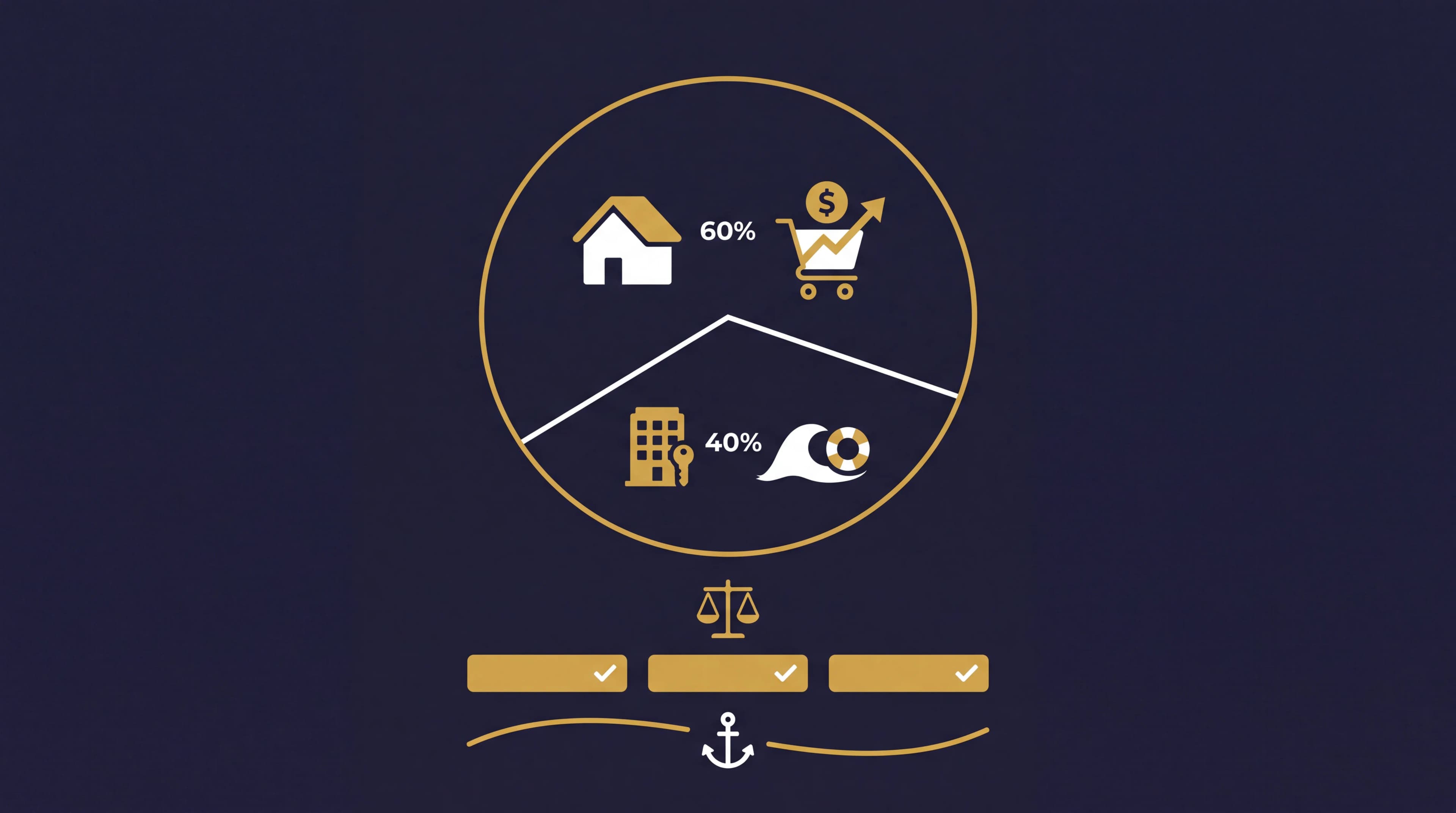
When housing consumes 40% of your paycheck, you must restructure traditional budgeting frameworks to survive. The most popular budgeting framework is the 50/30/20 rule. 50/30/20 rule — a budgeting method that divides your after-tax income into 50% for needs, 30% for wants, and 20% for savings and debt repayment.
When your rent eats up 40% of your income, that 50% "needs" category is almost entirely gone before you even buy groceries or pay for electricity.
Instead of throwing the entire framework out the window, you have to adapt it. Financial educators at NerdWallet suggest redefining your categories. Your "needs" will naturally have to expand. They now need to include housing, utilities, groceries, insurance, and minimum debt payments.
To make the math work, your "wants" category (dining out, entertainment, travel) will have to shrink. But you should fight to protect that 20% savings and debt repayment allocation. If you need help structuring this new reality, learning how to build your first budget in 30 minutes is a great place to start.
Matt Shapiro, a Certified Financial Planner, suggests treating the old 30% rule as a loose guideline rather than a strict law. If the choice is between spending a little extra on rent or living in an unsafe situation, you might have to accept a 40% rent-to-income ratio. The key is making sure you still have enough left over for your financial safety net.
Here's what this means: You must expand your "needs" category to accommodate high rent while shrinking your "wants," but you should never completely sacrifice your savings.
Protecting Your Financial Safety Net Despite High Housing Costs
Maintaining a financial safety net is the single most important step to prevent high rent from pushing you into debt. When housing costs are high, the easiest thing to cut is your savings rate. It feels harmless in the short term. But it leaves you incredibly vulnerable to unexpected expenses.
Brianna Scurry, a personal finance expert cited by the Financial Post, emphasizes that saving now prevents you from taking on high-interest debt later. She recommends building at least a $500 emergency fund as a non-negotiable priority. You need this even when rent consumes a large portion of your paycheck. If you're starting from zero, figuring out how to build a $1,000 emergency fund in 90 days can give you the exact steps to get there.
If your employer offers a 401(k) match, capturing that money is equally critical. An employer match is essentially a 100% return on your investment. Leaving it on the table because rent is high will severely impact your long-term financial security. Prioritize the emergency fund and the match. Then build the rest of your budget around what is left.
The bottom line: Prioritize building a $500 emergency fund and capturing any employer 401(k) match before allocating money to flexible lifestyle expenses.
Finding Wiggle Room in a High-Rent Budget
Reducing your transportation and recurring fixed costs is the fastest way to create breathing room in a tight budget. If rent takes up 40% and savings takes up 20%, you have 40% left for literally everything else. You have to get strategic about your remaining expenses.
Rethinking Transportation Costs
Look at the relationship between your rent and your transportation costs. Research from Washington University highlights a major flaw in the 30% rule. It completely ignores how location influences your other expenses.
For example, paying 40% of your income to live in a walkable neighborhood with strong public transit might actually save you money. It can be cheaper than paying 25% of your income to live in the suburbs. That cheaper suburban rent usually requires you to own a car, buy gas, and pay for auto insurance. If you live in a city with reliable transit, consider whether you actually need a vehicle. Ditching a car payment and insurance can easily free up hundreds of dollars a month.
Auditing Recurring Expenses
Audit your recurring expenses. Shop around for better cellphone plans and car insurance rates. Competition among carriers is fierce right now. You can often get the exact same coverage for less money simply by switching providers. Small, consistent changes (like bringing lunch to work a few days a week) are much more sustainable. They work better than trying to cut out all your fun spending at once.
Here's what this means: Paying higher rent in a walkable city might actually save you money if it allows you to eliminate the massive expense of car ownership.
Proven Strategies to Lower Your Housing Costs
Negotiating your lease and sharing space are the most effective tactics to immediately reduce your housing expenses. You don't always have to accept the sticker price on an apartment. Negotiating your rent is a highly effective way to bring your housing costs down.
Research your local rental market to understand current rates for similar units. If you find out that your building is charging more than the building next door, you have a strong bargaining chip. Landlords hate vacancies. An empty apartment costs them money every single day. If a unit has been vacant for more than 30 days, they are usually eager to make a deal.
You can offer to sign a longer lease, such as 18 or 24 months, in exchange for a lower monthly rate. If the landlord absolutely refuses to lower the base rent, ask them to waive the application fees or cover the move-in costs. Every dollar saved helps. If you're nervous about having this conversation, reading our guide on how to negotiate rent down with proven scripts will give you the exact words to use.
If living alone is simply too expensive, consider finding a roommate. A study by Trulia found that taking on a roommate in major rental markets can save an average of 13% of your income. Just make sure you use a reputable matching service. You should also sign a clear written agreement covering household expectations and bills.
The bottom line: Landlords value reliable tenants and hate vacancies, giving you leverage to negotiate lower rent, waived fees, or better lease terms.
The Rent vs. Buy Reality Check for Cost-Burdened Renters
Renting is not throwing money away; it is paying for flexibility and a predictable maximum housing cost. When you complain about high rent, someone will inevitably tell you that renting is throwing money away. They might say you should just buy a house. This advice is outdated and often dangerous for your budget.
According to Bankrate's housing affordability analysis (2024), the typical U.S. household now needs to spend 43% of its income just to purchase a median-priced home of $435,000. In coastal markets like Los Angeles or New York, you would need to devote two-thirds of your income to afford a standard home. Even in historically affordable Southern markets like Atlanta and Houston, buying a median-priced home requires 30% to 40% of a household's income.
According to the Federal Reserve's Economic Well-Being report (2024), 67% of renters cannot afford a down payment. Another 49% report they cannot afford monthly mortgage payments.
Buying a home also comes with hidden costs that renters don't pay. Property taxes, homeowners insurance, maintenance, and emergency repairs can easily add 25% to 50% to your base housing cost. When your furnace breaks in a rental, you call the landlord. When it breaks in a house you own, you're on the hook for thousands of dollars.
Renting gives you flexibility. It allows you to move for better job opportunities and keeps your maximum housing cost predictable. Don't let anyone pressure you into buying a home simply because your rent feels high. Buying before you're financially ready will only trade one form of financial stress for a much more expensive one.
Here's what this means: Don't rush into homeownership just because rent is high; buying a house comes with hidden costs that can easily exceed your current rental expenses.
Common Questions
Is it normal to spend 40% of your income on rent?
Yes, it is increasingly normal to spend 40% of your income on rent in today's housing market. According to recent census data, nearly half of all renters spend more than 30% of their income on housing, with millions spending 40% or more. High construction costs and low housing supply have made this a common reality for many full-time workers.
How do I budget if my rent is too high?
To budget when your rent is too high, you must adjust traditional frameworks by expanding your "needs" category and aggressively reducing your "wants." Focus on lowering fixed costs like transportation and subscriptions to free up cash. Always prioritize a small emergency fund to protect yourself from unexpected expenses.
Should I move if my rent is 50% of my income?
You should strongly consider moving or finding a roommate if your rent reaches 50% of your income, as this leaves very little room for basic living expenses and savings. However, before moving, calculate the total cost of relocation and transportation to ensure the new, cheaper apartment actually saves you money overall.
Can I negotiate my rent increase?
Yes, you can absolutely negotiate a rent increase with your landlord. Research comparable apartments in your area and use that data to request a lower rate or a longer lease term. Landlords want to avoid the cost of a vacant unit, giving good tenants significant bargaining power.
Your One Next Step
Pull up your bank and credit card statements from the last 90 days. Categorize your expenses into fixed costs (rent, insurance, debt payments) and flexible spending (groceries, dining out, subscriptions). You can't fix a budget until you know exactly where your money is going. Find just one recurring flexible expense you can cancel or reduce today. Automatically route that saved money into your emergency fund. Your Money. Your Terms.
Listen to this article
AI-generated audio · Voices by ElevenLabs
Get the 2026 Wealth Starter Kit
Free spreadsheet budget models, 2026 tax deduction checklists, and weekly practical playbooks. No spam, no affiliate shills.

Sammy Dynamo
Software Engineer | CS Student | Technopreneur, Dyxium Inc
Related Articles

12 min read
BudgetingAlign Bill Due Dates With Your Paycheck: The Budget Pivot
Learn how to align bill due dates with your paycheck to eliminate late fees and fix...
Sammy Dynamo
10 min read
BudgetingDynamic Budgeting: Adjusting When Rent and Gas Spike
Dynamic budgeting helps you adapt when rent and gas prices spike. Learn how to adjust your...
Sammy Dynamo
12 min read
BudgetingLease Renewal Math: Accept a Rent Hike or Move in 2026?
Facing a rent hike? Use this lease renewal math to decide if you should stay or...
Sammy Dynamo