How to Automate Your Finances in One Afternoon
How to Automate Your Finances in One Afternoon
You sit down with a cup of coffee on a Saturday morning. You open three different browser tabs. You check your checking account balance, log into your credit card portal, and try to remember if the electric bill is due on the 12th or the 15th.
It is exhausting. Managing money manually takes up mental space you could be using for literally anything else. Every time you have to remember to pay a bill or transfer money to savings, you are spending unnecessary time and energy.
There is a better way to handle your monthly cash flow. By spending just a few hours setting up a reliable system, you can remove yourself from the day-to-day mechanics of paying bills. You can put your money on autopilot.
The hidden cost of managing money manually
Many people believe that manually paying bills keeps them in touch with their finances. In reality, it usually just creates anxiety and increases the chance of making a mistake.
According to a 2023 financial literacy survey by NerdWallet, nearly one in four Americans missed a bill payment over a 12-month period. When asked why, the most common reason was not a lack of funds. People simply forgot. A missed payment often results in late fees of thirty dollars or more. If the payment is more than thirty days late, it can cause a significant drop in your credit score.
The Federal Reserve reports that while the majority of adults use mobile banking, many only use it to check their balances. They log in, look at the number, and then manually initiate payments. This manual process takes an average of one to two hours every month. Over a year, that is a full day spent just moving digital numbers from one screen to another.
Automation fixes this instantly. It removes human error from the equation. It ensures your bills are paid on time, your savings grow quietly in the background, and your credit score stays protected.
The psychology behind automatic finances
There is a reason why behavioral economists love automatic enrollment programs. Richard Thaler, a Nobel Prize winner in economics, has extensively studied how people make financial choices. His research shows that humans suffer from decision fatigue. Every choice we make drains our willpower.
If you have to actively decide to save fifty dollars at the end of every month, you are fighting an uphill battle. You have to choose saving over spending every single time. Usually, spending wins.
When you automate your finances, you only have to make the good decision once. You set the rule, and the system executes it. You take willpower completely out of the equation. You do not have to be disciplined every day. You just need to be disciplined for one afternoon while you set up your accounts.
The hub and spoke method
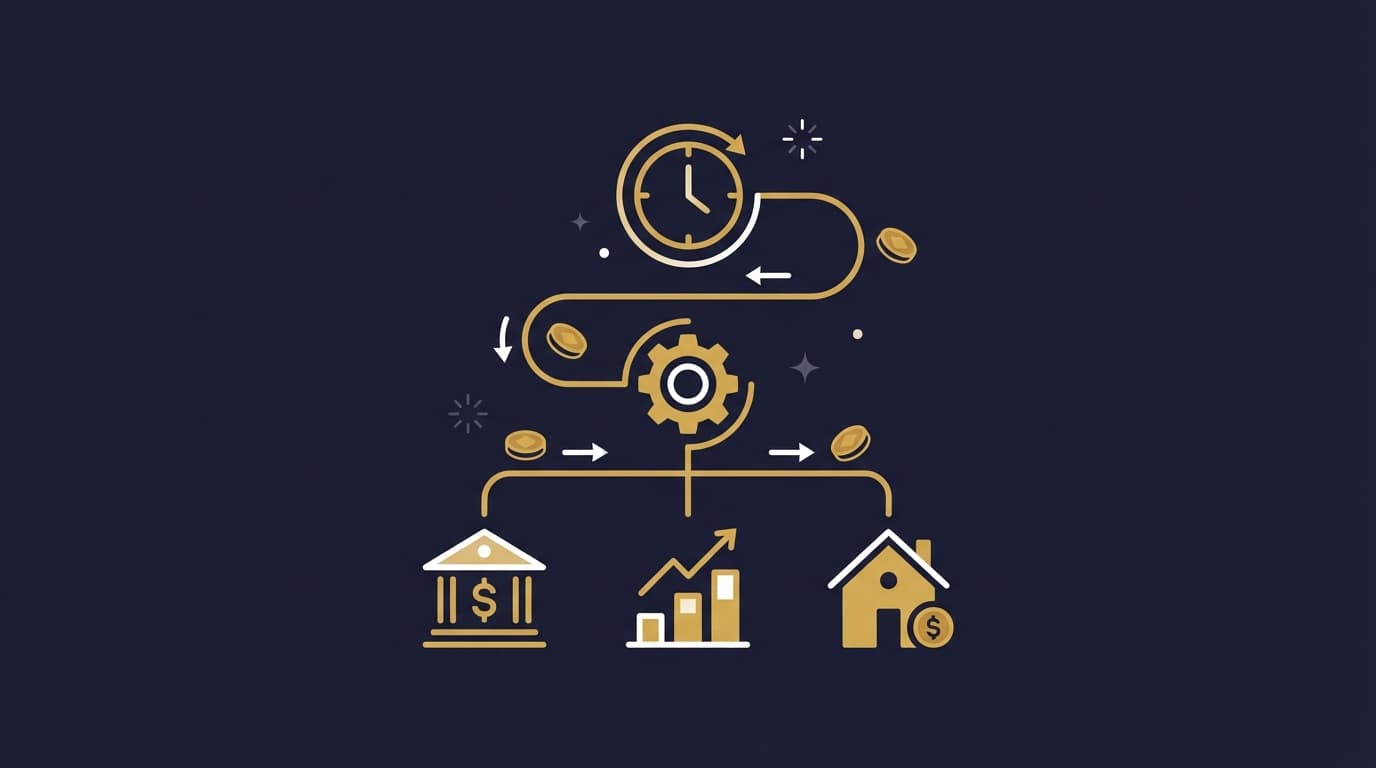
Before you start clicking buttons in your banking app, it helps to understand how a good automated system is structured. I like to use the hub and spoke method.
Your main checking account is the hub. This is where your paycheck lands. It is the central clearinghouse for your money.
The spokes are all the places your money needs to go. These include your savings accounts, your utility providers, your landlord or mortgage lender, and your credit card companies.
The goal of automation is to set up reliable, predictable pipelines from your hub to your spokes. Money flows into the hub on payday and gets automatically pushed out to the spokes over the next few days. You are left with a smaller, clearly defined amount of money in your checking account. That remaining money is what you can safely spend on groceries, gas, and fun.
Step 1: Track your predictable numbers
You cannot automate what you do not understand. Before you set up any automatic transfers, you need a clear picture of your cash flow.
Take thirty minutes to look through your last two months of bank statements. Write down every fixed expense you have. These are the bills that cost the exact same amount every month. Your rent, your internet bill, your gym membership, and your car insurance fall into this category.
Next, write down the dates you get paid. If you are paid on the 1st and the 15th, note that. If you are paid every other Friday, pull up a calendar and highlight those days.
Knowing when money enters your account and exactly how much needs to leave your account is the foundation of this entire process. If you need help organizing these numbers, taking a step back and building your first budget is a great place to start.
Step 2: Automate your savings first
This is the most critical step. If you wait until all your bills are paid and all your weekend plans are funded to see what is left for savings, you will usually find nothing left. You have to pay yourself first.
Log into your bank and open your savings account portal. Set up a recurring transfer from your checking account to your savings account.
Timing is everything here. I highly recommend scheduling this transfer for the day after your paycheck typically clears. If you get paid on the 1st, schedule the transfer for the 2nd.
By moving the money immediately, you never see it sitting in your checking account. You never feel tempted to spend it. It just vanishes into your savings. Even if you only start with twenty dollars a paycheck, the consistency is what matters. This is the exact strategy you should use when building a $1,000 emergency fund.
Step 3: Put your fixed bills on autopilot
Now it is time to deal with your monthly obligations. There are two ways to automate bills: you can have the merchant pull the money, or you can have your bank push the money.
A "pull" is when you give your internet provider your debit card or routing number and authorize them to charge you every month. A "push" is when you use your bank's online bill pay feature to send a check or electronic transfer to the internet provider on a specific date.
The Consumer Financial Protection Bureau advises consumers to be careful with automatic payments given directly to merchants. If a company makes a billing error and pulls three times the normal amount from your checking account, it can take weeks to get that money back.
Whenever possible, use your bank's bill pay feature to push the money. This keeps you in control. You tell the bank exactly how much to send and when to send it.
Log into your bank, go to the bill pay section, and add your landlord, your utility companies, and your insurance providers. Schedule the payments to go out a few days before the due dates.
Step 4: Create a safety net for debt payments
Credit cards and student loans are a bit different because the balances fluctuate. You cannot always predict the exact statement balance.
However, you can still automate a safety net. Log into your credit card accounts and your loan portals. Find the automatic payment settings. Set up an automatic payment for the minimum amount due, scheduled for five days before the actual due date.
This is your backup plan. Your goal should always be to pay your credit card statement balance in full every month. But life happens. You might get sick, travel without internet access, or simply forget to log in. If that happens, the automatic minimum payment will process. You will avoid late fees and protect your credit score.
You can still log in manually during the month to pay the rest of the balance. This automated step just ensures you never miss a deadline while you are paying off debt starting from zero.
How to handle the fear of overdrafts
The biggest reason people hesitate to automate their finances is the fear of overdraft fees. It is a valid concern. If an automatic payment hits your account before your paycheck clears, your bank might charge you a thirty-five dollar fee.
There are two ways to completely eliminate this risk.
First, build a buffer in your checking account. This takes time, but it is incredibly effective. Aim to keep an extra half-month of expenses sitting in your checking account at all times. This money is not for spending. It is just a shock absorber. If a bill processes a day early or a paycheck clears a day late, the buffer covers the gap.
Second, align your billing dates. You do not have to accept the due dates your providers give you. Most credit card companies, utility providers, and cell phone carriers will happily change your billing date if you ask.
Call your providers and ask them to move your due dates to a few days after you get paid. If you get paid on the 15th, ask for your bills to be due on the 20th. This ensures your checking account is always full when the automatic payments trigger.
The manual review (because automation is not magic)
There is a common misconception that automating your finances means you can completely ignore your money. That is dangerous. Automation handles the heavy lifting, but you are still the manager of your money.
Systems break. Credit cards expire. Companies raise their subscription prices without making it obvious. If you never look at your accounts, you might pay for a streaming service you stopped watching six months ago.
You need a monthly review routine. Set a recurring calendar appointment for the first Sunday of every month. Call it your financial check-in.
During this fifteen-minute appointment, you only need to do three things. First, scan your checking account transactions to make sure you recognize all the charges. Second, check your savings account to verify your automatic transfers actually went through. Third, look at your credit card statements to catch any price increases on your subscriptions.
That is it. You are not manually paying bills or doing complex math. You are just acting as a supervisor, making sure the automated system is doing exactly what you told it to do.
Your One Next Step
Do not try to automate your entire life in the next ten minutes. Pick just one thing. Log into your primary checking account right now and set up a recurring automatic transfer to your savings account. Even if it is just twenty dollars a month, schedule it to happen the day after your next paycheck. Once you see how easy it is to save without thinking about it, you can come back and automate the rest of your bills.
Your Money. Your Terms.
Listen to this article
Get smarter about money
One practical tip per week. No spam, no hype — just clear steps toward financial progress.

Sammy Dynamo
Software Engineer | CS Student | Technopreneur, Dyxium Inc
Related Articles
10 min read
BudgetingRent is 40% of Your Income? How to Budget and Survive
When rent is 40% of your income, traditional financial advice fails. Learn how to adapt your...
Sammy Dynamo
11 min read
BudgetingBare-Bones Budget for Layoffs: Find Your Survival Number
A bare-bones budget is your ultimate defense against a layoff scare. Learn how to calculate your...
Sammy Dynamo
11 min read
BudgetingMarried but Separate Finances: How to Manage Money Together
Managing married but separate finances is the new normal. Learn how to handle separate bank accounts...
Sammy Dynamo