Your Job Is Changing in 2026: The AI Reskilling Roadmap
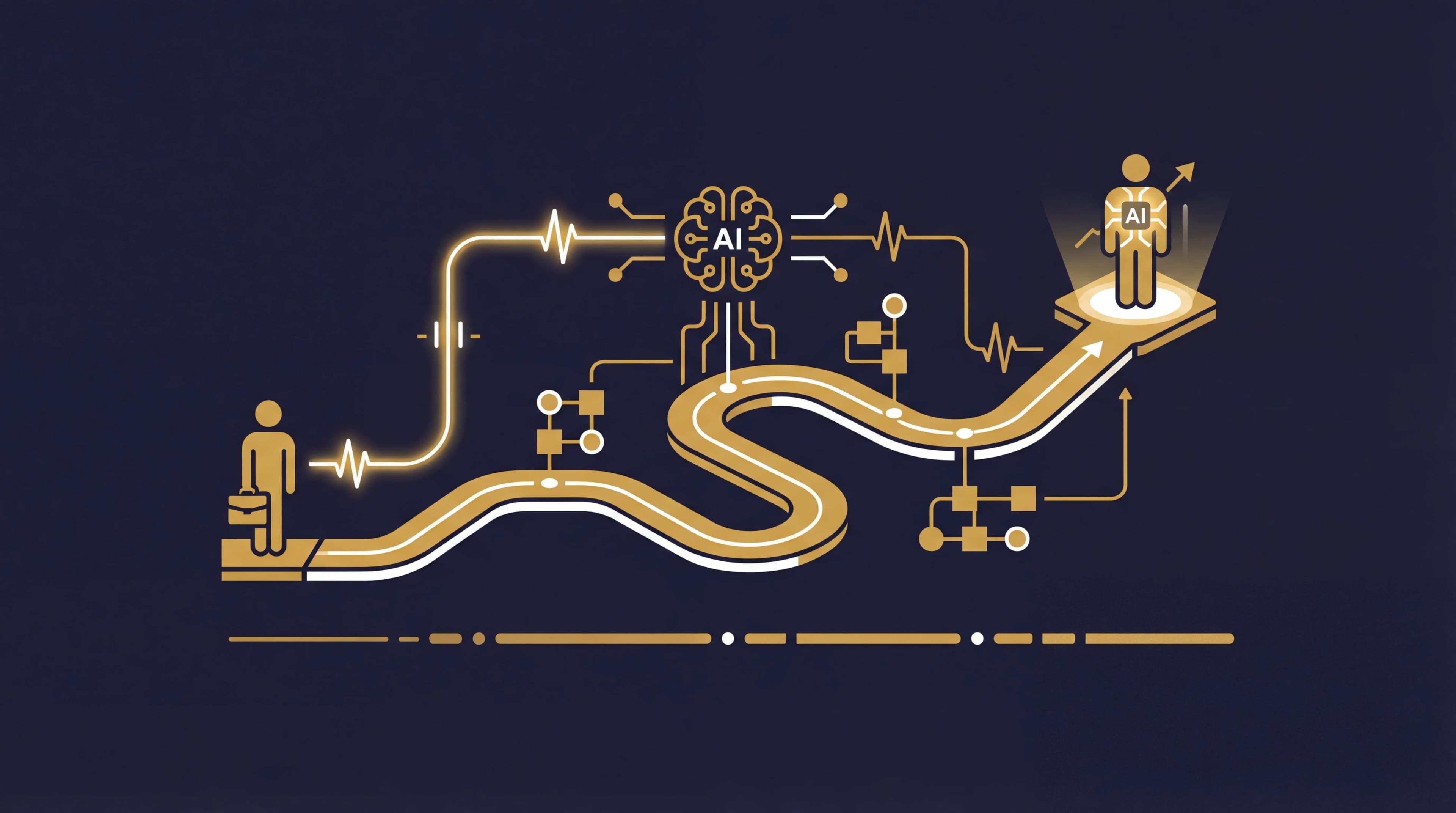
Your Job Is Changing in 2026: The AI Reskilling Roadmap
If you read the news lately, you might think a robot is waiting in the lobby to pack up your desk. The headlines are loud, the predictions are scary, and the anxiety is very real.
But when you look at the actual employment data for 2026, a completely different story emerges. We are not facing a sudden job apocalypse. Instead, we are living through a massive, quiet restructuring of what we do at work all day.
Research from Anthropic and Stanford University shows that artificial intelligence is not eliminating jobs at scale. It is rapidly automating specific, repetitive tasks within those jobs. If you spend your day doing routine data entry or basic customer service, your daily workflow is already changing.
The stakes for your income are high. The World Economic Forum estimates that 80% of the global workforce will need to pick up new AI-related skills by 2027 just to stay competitive. That sounds intimidating, but it is actually a massive opportunity if you know where to look.
Let us look at the real numbers behind the AI job market, which careers are genuinely safe, and exactly how you can protect your paycheck this year.
The Real Story Behind AI Job Losses (And Gains)
It is easy to let the fear of automation get to you. If you are managing financial anxiety already, the idea of a computer taking your livelihood is a heavy burden. But the actual data from the U.S. labor market tells a more nuanced story.
Outplacement firm Challenger, Gray, & Christmas tracked job cuts closely through 2025. They found roughly 17,375 job cuts directly attributed to AI. While every lost job is a painful reality for that worker, we have to put that number in context. In August 2025 alone, there were 5.1 million total job separations in the American economy. AI-related job losses represented less than one percent of total labor market churn.
Here is the part that rarely makes the evening news. AI is currently creating more jobs than it destroys.
In 2024, AI growth generated more than 119,900 direct jobs. These were not just for advanced computer scientists. Building the physical infrastructure for AI requires massive manpower. Each large-scale data center takes up to three years to build and requires roughly 1,500 on-site workers. This created over 110,000 construction jobs in a single year.
The real threat right now is not mass layoffs of experienced workers. The threat is something economists call "hiring avoidance."
Companies are simply choosing not to hire new entry-level workers. Research from Anthropic found that early-career workers aged 22 to 25 in highly exposed occupations have seen a 13% decline in employment. Companies are using AI to do the basic work that a junior employee used to handle, making it harder for recent graduates to get their foot in the door.
The Jobs Facing the Most Heat Right Now
To protect your career, you need to know exactly where the pressure is building. The jobs experiencing the most measurable decline are those filled with highly repetitive, text-based, or data-heavy tasks.
A Resume.org survey of nearly 1,000 U.S. business leaders found that 21% of companies have already stopped hiring entry-level workers because of AI. Another 36% say they will stop by the end of 2026.
Data entry clerks and administrative assistants face the most acute pressure. One major analysis found that data entry clerks face a projected 40% decline. Generative AI can simply read, sort, and input data faster and more accurately than a human typing at a keyboard.
Junior content writers and freelance translators are also feeling the squeeze. Western language translation jobs dropped by 50% as tools like Google Translate and specialized AI models became highly accurate for routine text.
Even medical billing and insurance verification roles are shrinking. Automated platforms now handle the initial processing of prior authorizations and visit notes.
However, these fields are not vanishing entirely. They are evolving. Displaced customer support workers are transitioning into customer success roles or quality assurance. They are moving from answering basic questions to managing complex client relationships that require a human touch.
The Safe Havens: Careers AI Cannot Touch
If you are looking for long-term job security, you want to look at careers that require high-fidelity physical dexterity, deep human empathy, or complex strategic judgment.
Healthcare is the strongest growth sector in the economy. The U.S. Bureau of Labor Statistics (BLS) projects healthcare and social assistance to be the fastest-growing industry sector through 2034.
Consider a Certified Nursing Assistant (CNA). A CNA performs 85% to 90% hands-on tasks every single day. They recognize subtle signs of patient distress, safely assist with physical transfers, and provide emotional comfort. A robot cannot do this. Even advanced care robots costing over $60,000 require constant human oversight. The BLS projects 216,000 CNA job openings annually, and the training takes only 4 to 12 weeks.
Nurse practitioners are projected to see a massive 45.7% growth by 2032. The aging population needs chronic disease management and human care that an algorithm simply cannot provide.
The skilled trades are another fortress of job security. Electricians, plumbers, HVAC technicians, and construction workers are incredibly safe from automation. Robots lack the physical dexterity and real-time problem-solving skills to navigate a half-built house or fix a leaky pipe in a 100-year-old building. Solar photovoltaic installers are projected to grow 48% by 2033, and wind turbine technicians are right behind them at 49.9%.
Finally, roles requiring strategic judgment and creativity remain highly protected. A lawyer who just fills out legal templates is at risk. But a lawyer who negotiates, strategizes, and builds deep trust with a client is irreplaceable. AI can generate a list of options, but human judgment is required to decide which option makes sense in the real world.
The 60-Day Reskilling Reality Check
Hearing that 80% of the workforce needs new skills by 2027 can induce panic. But reskilling does not mean you have to go back to college for four years to study advanced mathematics.
You do not need to become a programmer. You just need to become AI-literate.
In February 2026, the U.S. Department of Labor released a comprehensive AI Literacy Framework. It defines the basic skills workers need today. These include understanding basic AI concepts, directing AI with clear instructions, and critically evaluating the output to make sure it is accurate. None of these require coding skills.
You can achieve this basic competency in about 60 days. With daily practice and a few small projects, you can move from a complete beginner to a highly capable AI user. The tools are designed to be used with plain English. If you can write a clear email, you can learn to direct an AI assistant.
This is why building a $1,000 emergency fund is so important. Having a small financial buffer gives you the breathing room to spend your evenings or weekends learning a new skill without panicking about next week's groceries.
Government and Private Money to Fund Your Training
You do not have to drain your savings to learn these new skills. There is a massive amount of funding available right now for workers who want to adapt.
The federal government provides nearly $3 billion in state grants through the Workforce Innovation and Opportunity Act (WIOA). In 2026, the Department of Labor specifically encouraged states to use these funds for AI literacy programs. Depending on your state, you might qualify for completely free training.
A major change happens on July 1, 2026, when Workforce Pell goes into effect. This allows students to use federal Pell Grants for short-term, high-quality training programs that last just a few weeks or months. You no longer have to commit to a full degree program to get financial aid for technical training.
Private companies are also stepping up. Google AI Essentials is a completely free foundational course that covers AI basics and prompt design. Coursera offers free enrollment seats for displaced workers, covering generative AI and data science. Major employers like Amazon and Meta have signed pledges to provide free AI education resources to the public.
Three Ways to AI-Proof Your Income This Year
Depending on your current job and your financial stability, you have three practical strategies to protect your career in 2026.
1. Move Up (Deepen Your Current Position)
If you are in a job that is exposed to AI, your best immediate move is to become the person who knows how to use the tools. You want to shift from doing the repetitive work to managing the AI that does the repetitive work.
Take a free course like Google AI Essentials. Then, pick one routine task at your job and use an AI tool like ChatGPT or Claude to automate it. Document your results. Did it save you two hours a week? Did it reduce errors? Show this to your manager.
By doing this, you make yourself more valuable to your current employer. You also build a concrete portfolio project to talk about in your next job interview. AI creates the most productivity gains for workers who have strong industry knowledge and know how to direct the software effectively.
2. Move Adjacent (Pivot Your Transferable Skills)
If your specific role is shrinking, look at related jobs that require human judgment. This usually takes three to six months of focused learning while you continue to work your current job.
For example, if you are an administrative assistant, you already know how to manage schedules, coordinate projects, and communicate with stakeholders. With a few weeks of training, you can transition into an AI Operations Coordinator. You would use your organizational skills to manage the AI tools that the rest of the company relies on.
If you are a junior accountant, you can pivot toward financial planning or client advisory roles. You let the software do the heavy math, while you focus on explaining the strategy to the client. This is a great time to consider starting a side business to test these new advisory skills in the real world before making a full career leap.
3. Move Out (Transition to a Safe Field)
If your current field is highly exposed and you have the resources to make a bigger change, transitioning to a structurally protected field is the strongest long-term move.
This requires more time and effort, usually six to twelve months of training. But the payoff is absolute job security.
You could get your CNA certification in under three months for less than $2,500, stepping immediately into a field with massive demand. You could look into a physical therapist assistant program, which takes two years and offers a median wage of over $63,000. Or you could pursue an electrician apprenticeship, where you earn money while learning a trade that robots will not be able to touch in our lifetimes.
Your One Next Step
Reading about economic shifts can feel overwhelming, so let us focus on one single action you can take this week to protect your income.
Sign up for a free introductory AI course, like Google AI Essentials or a beginner track on Coursera. Spend just two hours this weekend learning the basic terminology and how to write a clear prompt. Then, use an AI tool to draft one email or summarize one document for your job next week.
You do not need to predict the future of the global economy. You just need to learn how to use the tools in front of you today. Your money and your career are still in your control.
Listen to this article
Get smarter about money
One practical tip per week. No spam, no hype — just clear steps toward financial progress.

Sammy Dynamo
Software Engineer | CS Student | Technopreneur, Dyxium Inc
Related Articles
12 min read
Personal DevelopmentWhat to Ask a Financial Advisor: A Young Pro’s Checklist
Not sure what to ask a financial advisor? From fees to fiduciary duty, use this checklist...
Sammy Dynamo
11 min read
Personal DevelopmentAdult Children at Home: Protect Your Retirement
Having adult children at home is common, but it shouldn’t ruin your finances. Ready to share...
Sammy Dynamo
11 min read
Personal DevelopmentUpskill While Working: Beat the Reskilling Crisis
With 59% of workers needing new skills by 2030, you must adapt. Discover how to upskill...
Sammy Dynamo